
Grief moves slower than courts do. Families sitting at a kitchen table in Renton or Spokane or Bellingham after losing a parent aren’t thinking about filing deadlines. Creditor notice periods don’t come up either. They’re thinking about dad’s chair, who gets the Subaru, and whether anyone remembered to cancel the utilities. Then the mail piles up, and somebody finally asks: what do we do with the house?
That question sends a lot of people down a frustrating rabbit hole of legal jargon and conflicting advice. Let me lay out exactly how probate works in Washington State, how long it actually takes, and what it costs. You’ll also see whether you can sell the house before the whole process wraps up. No runaround.
What’s on this page
- What Is Probate in Washington State?
- What Assets Have to Go Through Probate in Washington State?
- What Happens If Someone Dies Without a Will in Washington State?
- How Does the Probate Process Work in Washington State?
- How Long Does Probate Take in Washington State?
- What Factors Affect How Long Probate Takes in Washington State?
- How Much Does Probate Cost in Washington State?
- What Are the Most Common Probate Mistakes in Washington State?
- How to Speed Up the Probate Process in Washington State
- Can You Sell a House Before Probate Is Finished in Washington State?
- How to Avoid Probate in Washington State?
- When Do You Need a Probate Lawyer in Washington State?
- How an Estate Planning and Settlement Lawyer Can Help with Probate in Washington State
- Frequently Asked Questions
- Probate Home Sales Across Everett and Snohomish County
- Talk It Through Before You Commit to Anything
What Is Probate in Washington State?
Skeptical sellers push back on this one right away. Our family agreed on everything, they say, so do we really need to go through court? Sometimes, yes. Sometimes, no. The answer depends on what the deceased owned and how they held title, not on whether the family got along.
Probate is the court-supervised process of verifying a will, formally appointing someone to manage the estate, settling outstanding debts and taxes, and finally transferring assets to the people who inherit them. It involves validating the will, appointing a personal representative, gathering assets, paying debts, filing any required tax returns, and making distributions to the beneficiaries. In Washington, that court is the Superior Court in the county where the deceased person lived. A King County estate goes to Seattle, a Pierce County estate goes to Tacoma, and so on.
Washington operates under its own probate statutes rather than the Uniform Probate Code used by many other states. Washington gives executors, called “personal representatives” under Washington law, a specific set of powers and responsibilities. That terminology matters. Everything you read about probate in other states may not translate cleanly to how things work here. States like California require court approval for nearly every estate transaction, which can add months to a timeline. Washington sidesteps that through its nonintervention system, a real advantage when you’re selling inherited property.
One feature sets Washington apart more than any other: the nonintervention powers system. Most estates can be completed within several months when the personal representative is granted nonintervention powers under RCW 11.68.011. Compare that to states where every estate transaction goes back before a judge for sign-off. In my experience that adds many months to an already exhausting process.
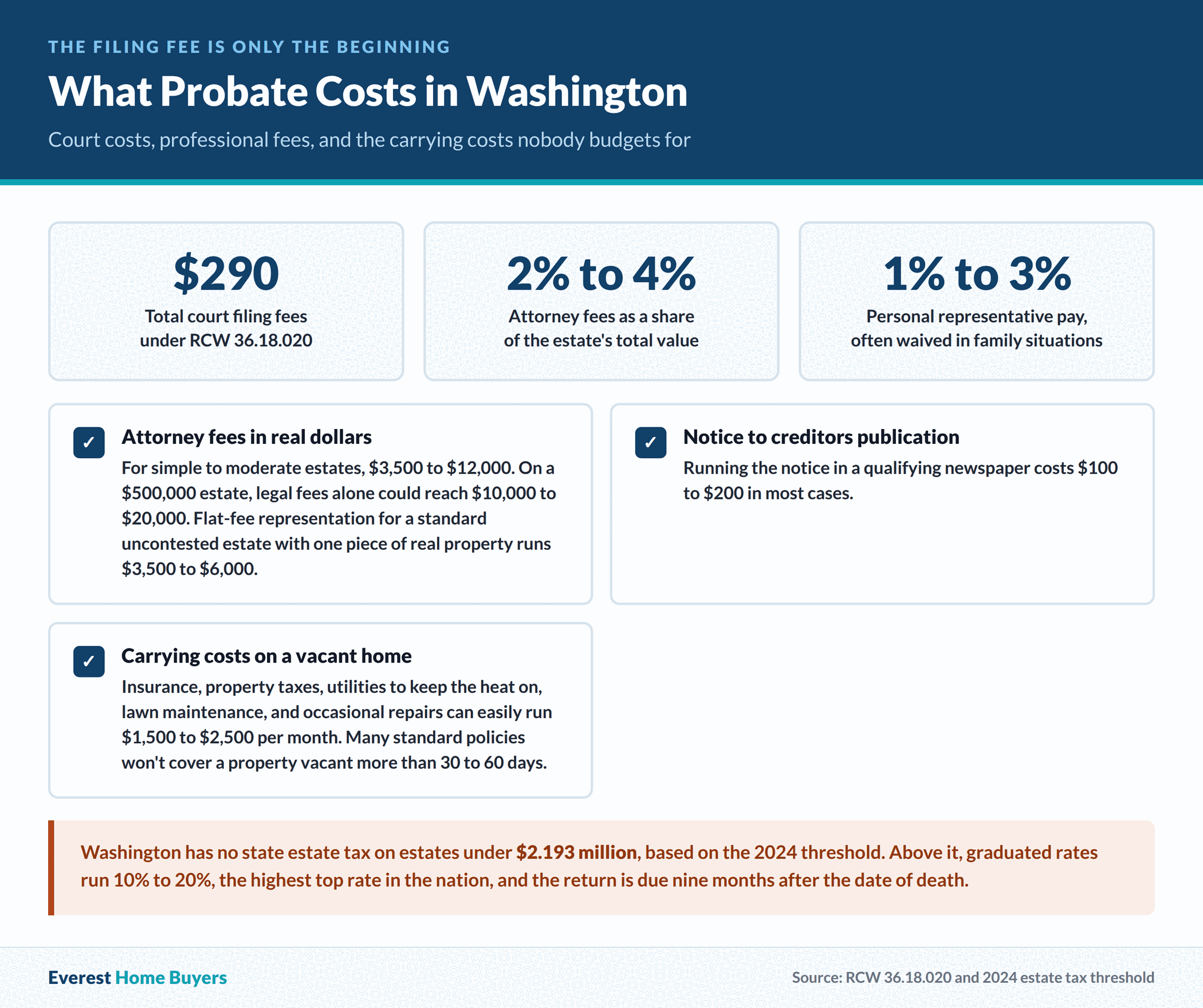
If probate is necessary, the person named in the will as executor files that will along with a document called a petition for probate. The petition contains a request to be formally appointed. Total filing fees amount to $290, which is a $200 filing fee plus two surcharges of $40 and $50. That fee is set by statute under RCW 36.18.020.
One more thing people underestimate: probate is a public process. All three filings, the petition, the inventory, and the creditor notice, become part of the public court record. For families with complicated assets or fractured relationships, that visibility matters. A neighbor, a business creditor, or a distant relative can walk into the courthouse and read the filing. Transparency here is by design, meant to protect creditors and heirs alike. Still, it’s worth knowing before you assume the process is private.
What Assets Have to Go Through Probate in Washington State?
Not everything a person owns has to pass through probate, and that’s where a lot of confusion starts. Probate catches assets titled solely in the decedent’s name with no built-in transfer mechanism. That’s the short version.
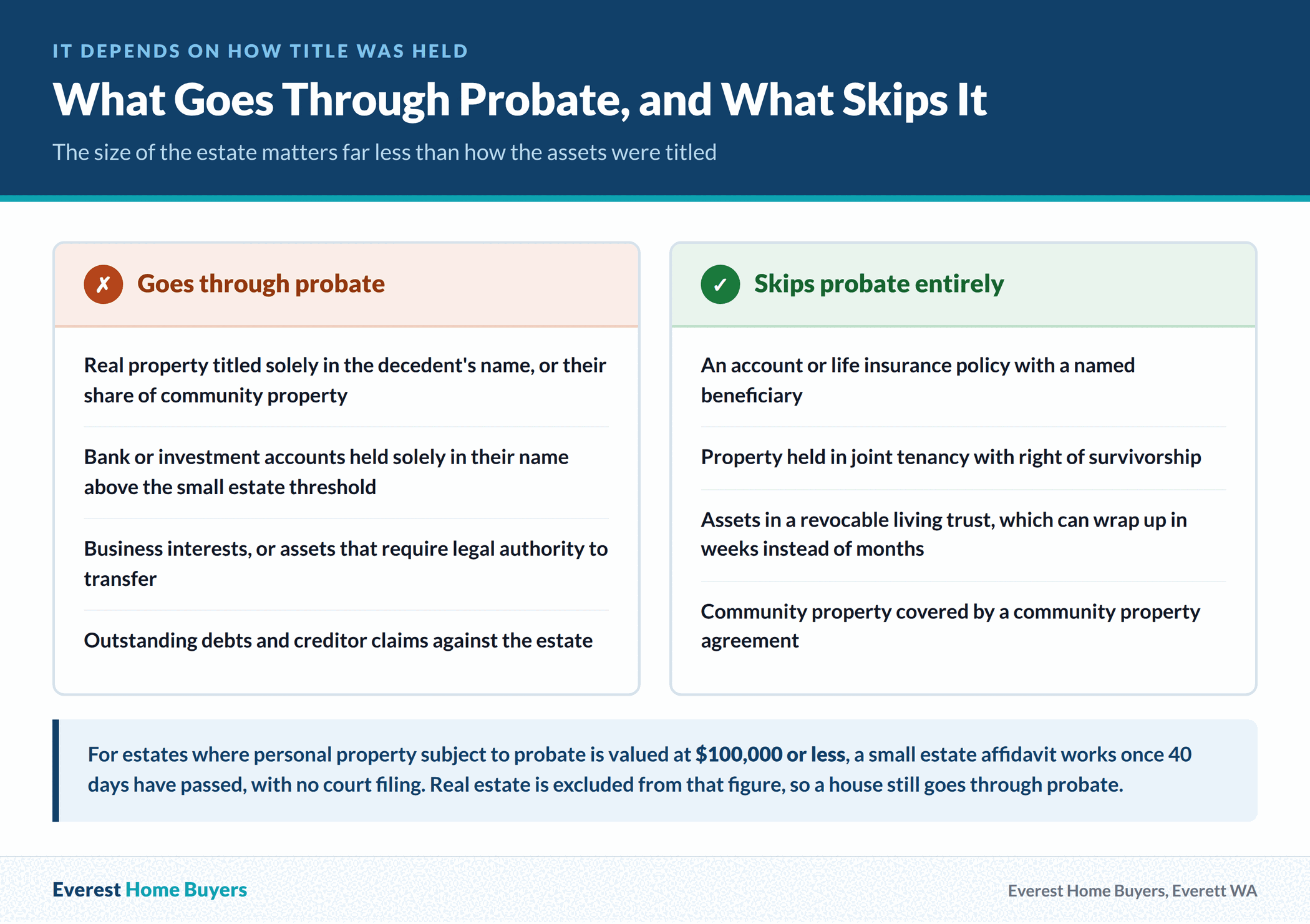
Probate is needed when the decedent owned real property titled solely in their name, or as their share of community property. It’s needed when bank accounts or investment accounts were held solely in the decedent’s name and exceed the small estate threshold. Business interests, or assets that require legal authority to transfer, put the estate in the same position. Outstanding debts and creditor claims do too.
Assets that skip probate entirely make a long list. A checking account with a named beneficiary goes straight to that person. Life insurance with a designated beneficiary never touches the estate. Property held in joint tenancy with right of survivorship transfers automatically to the surviving owner on death. A revocable living trust passes assets directly to the trust beneficiaries with no court involvement at all, and the whole process can wrap up in weeks instead of months.
Washington is also a community property state. Marital assets usually split 50/50, which affects estate planning and the tax treatment of inherited property. Spouses in Washington can also sign a community property agreement, which lets the surviving spouse take the deceased spouse’s half without going through probate. Your estate planning attorney can confirm whether one is in place.
For estates where the decedent’s total personal property subject to probate is valued at $100,000 or less, a small estate affidavit process is available. Real estate is excluded from that figure. At least 40 days must have passed since death, and no personal representative appointment can be pending. Presented directly to banks or other asset holders, the affidavit requires no court filing. This procedure does not cover real estate transfers.
A practical example helps. Say a parent in Yakima owned a home in their name alone, had a checking account with no beneficiary designation, and held a brokerage account the same way. Full probate would likely be needed even if the total estate value was modest. Now take a parent in Everett who held the same home in joint tenancy with an adult child. She had a payable-on-death designation on the bank account and named a beneficiary on the brokerage account. That one might leave no probate assets at all. What matters isn’t the size of the estate. It’s how the assets were titled and structured.
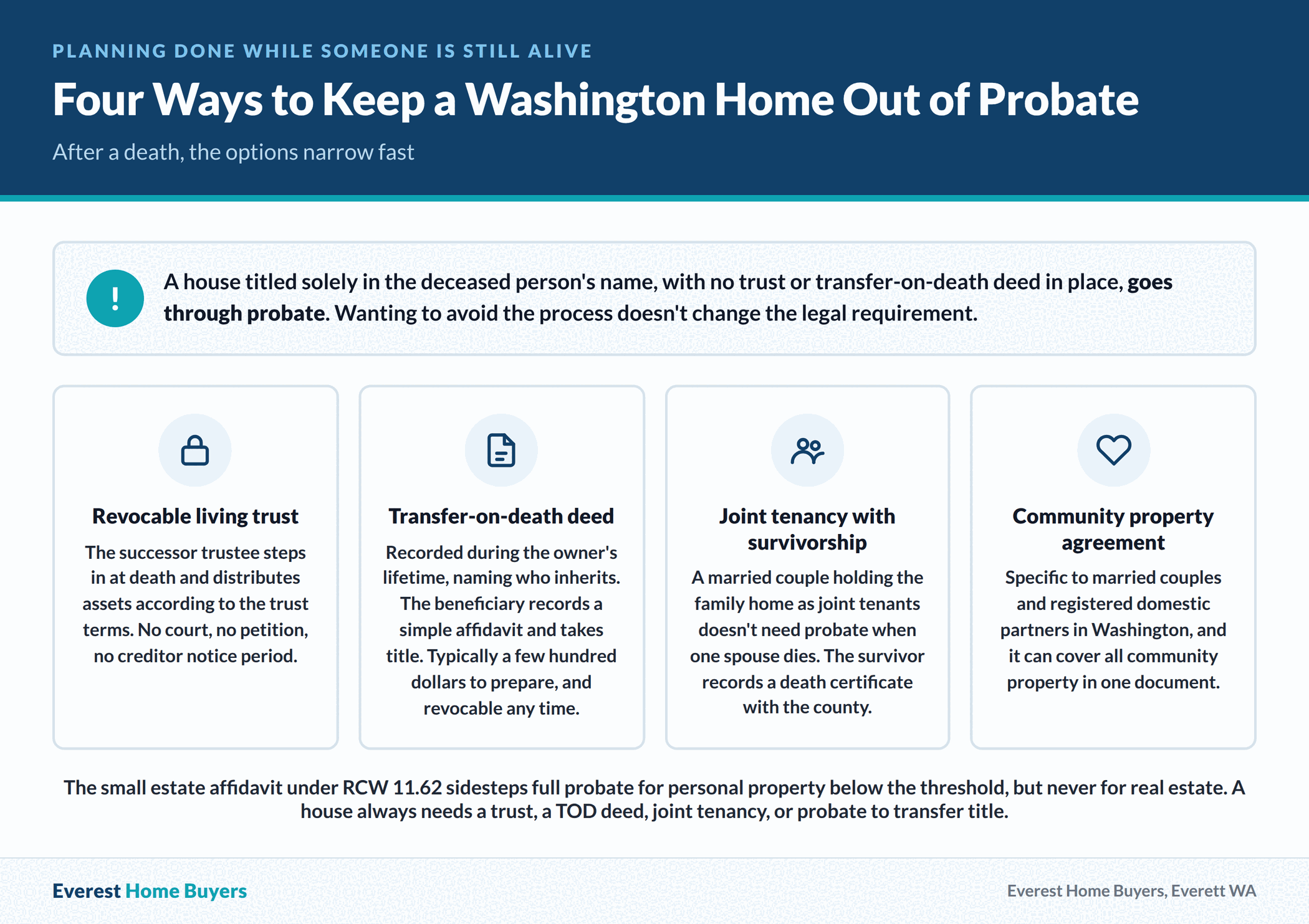
So if a house is titled solely in the deceased person’s name, and there’s no trust or transfer-on-death deed in place, that property goes through probate. Period. Wanting to avoid the process doesn’t change the legal requirement.
What Happens If Someone Dies Without a Will in Washington State?
A family in Puyallup handled everything smoothly while mom was alive. She had accounts, a house, and a clear sense of who should get what. She just never signed a will. After she passed, the family learned that what she wanted and what the law required weren’t the same thing.
Dying without a will is called dying “intestate,” and Washington has a specific set of rules for who inherits what. In intestate cases with no will, state laws determine how assets get divided among surviving spouses, children, parents, siblings, or other relatives, based on a strict order of priority. The court doesn’t ask what the deceased would have wanted. It follows the statutory formula.
Under Washington’s intestate succession rules, if the deceased was married with children who are also the children of the surviving spouse, the entire estate usually goes to that spouse. Children from a prior relationship change the math. The estate may be split between the surviving spouse and those children, which surprises families who assumed the spouse would simply take everything. A surviving spouse might receive three-quarters of the separate property while the deceased’s children share the remaining quarter, regardless of what the deceased actually intended.
If there is no will, or the person named in the will isn’t available or willing to serve, the probate court will appoint an administrator. A surviving spouse or registered domestic partner has first priority for that appointment. That’s under RCW 11.28.120.
Intestate estates often take longer than estates with a clear will. Locating all potential heirs, notifying them, and getting everyone aligned eats weeks. If an heir objects to the administrator’s appointment or disputes the distribution, the whole thing grinds to a halt while lawyers sort it out in court.
A few years back, I bought a home in Burien from a family going through exactly this. No will, four adult children, and a rental house their father had owned for decades. They couldn’t list the property until the court formally appointed an administrator. That pushed the timeline back by almost three months. Two weekends of open houses drew no serious buyers, so they came to us, and we closed on a Wednesday. A detached garage full of tools none of them wanted to haul away came with the house, and we handled it (tools, old paint cans, the works). One signed document from the father would have spared them all of it.
Many families in intestate situations miss a useful detail. RCW 11.68.011(1) lets a personal representative petition for nonintervention powers whether the decedent died testate or intestate. Even without a will, the estate can move without constant court supervision once an administrator is appointed.
How Does the Probate Process Work in Washington State?
For years I thought probate in Washington was always a long, court-heavy ordeal. It’s not. The process moves quickly when the right powers are in place from the start.
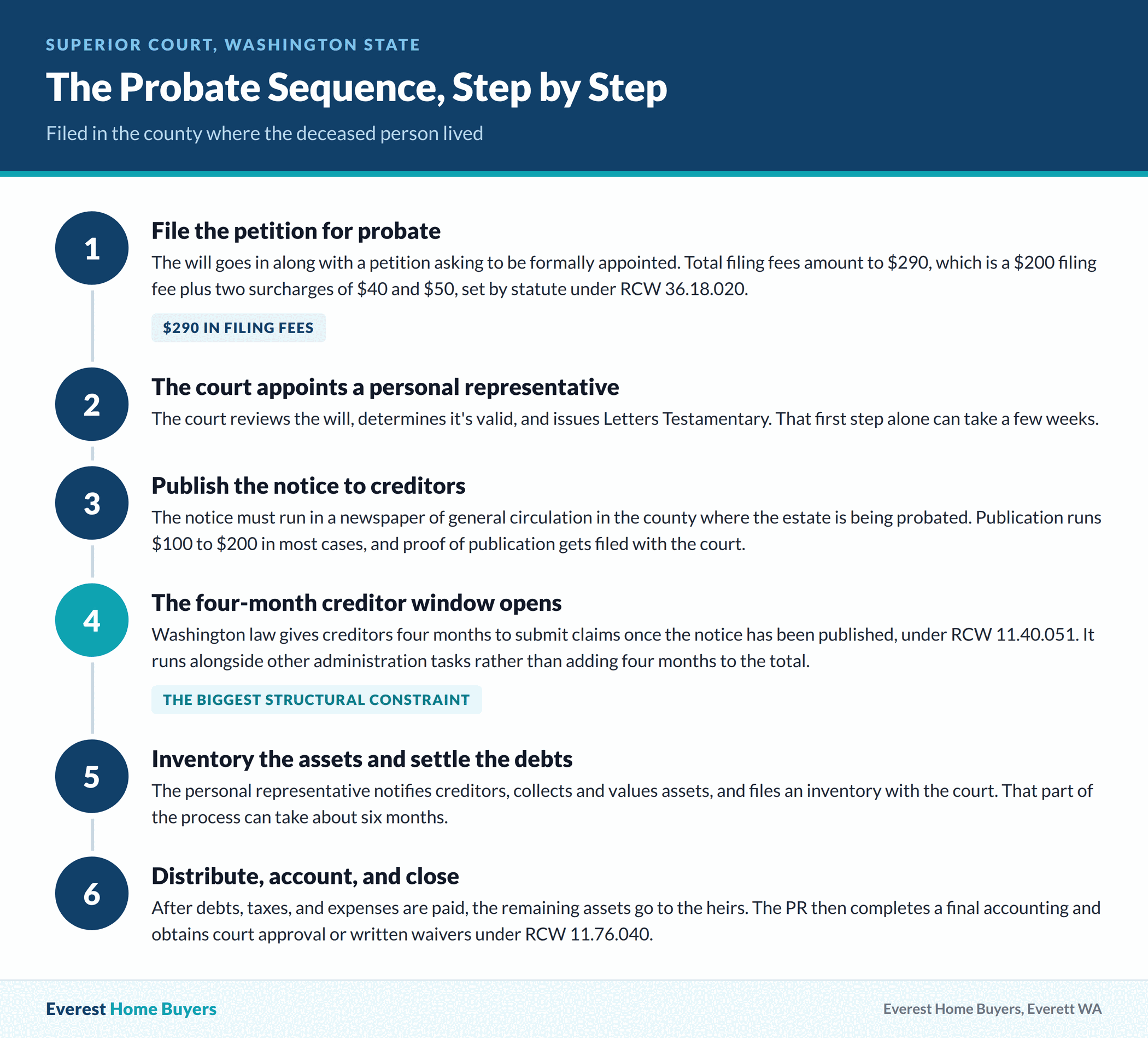
The sequence runs like this. Someone files a petition for probate with the Superior Court in the county where the deceased lived. During probate, the court reviews the will if one exists, determines it’s valid, and formally appoints the personal representative by issuing Letters Testamentary. Those letters give the personal representative legal authority to act on behalf of the estate.
Once appointed, the personal representative must notify creditors, collect and value assets, and file an inventory with the court. That part of the process can take about six months. Washington law gives creditors four months to submit claims against the estate once the creditor notice has been published. The four-month creditor period comes from RCW 11.40.051. It runs alongside other estate administration tasks, so it doesn’t necessarily add four months to the total timeline.
The creditor notice itself must run in a newspaper of general circulation in the county where the estate is being probated. Your fastest check is the county clerk’s office, which keeps a list of qualifying publications. In King County that might be the Daily Journal of Commerce. In Whatcom County it might be the Bellingham Herald. Your attorney or the county clerk’s office can confirm which publications qualify where you are. Publication costs vary but run $100 to $200 in most cases, and the proof of publication must be filed with the court.
Washington’s nonintervention powers let personal representatives sell estate property without court approval, as long as the will authorizes it. That makes the probate home sale process faster than in states that require court authorization for every transaction. When nonintervention powers aren’t granted, the personal representative has to petition the court for permission before selling real estate, and that slows things down considerably.
After all debts, taxes, and other expenses have been paid from the estate, the personal representative distributes the remaining assets to the rightful heirs. The will or Washington intestate succession laws dictate who gets what. The personal representative must then complete a final accounting and obtain court approval or written waivers under RCW 11.76.040.
How Long Does Probate Take in Washington State?
A family in Kirkland called me after their father passed. The estate was clean: one house, a savings account, a clear will. They expected to list the house within a few weeks. Six months later they were still waiting on the creditor period to clear before they felt comfortable accepting an offer.
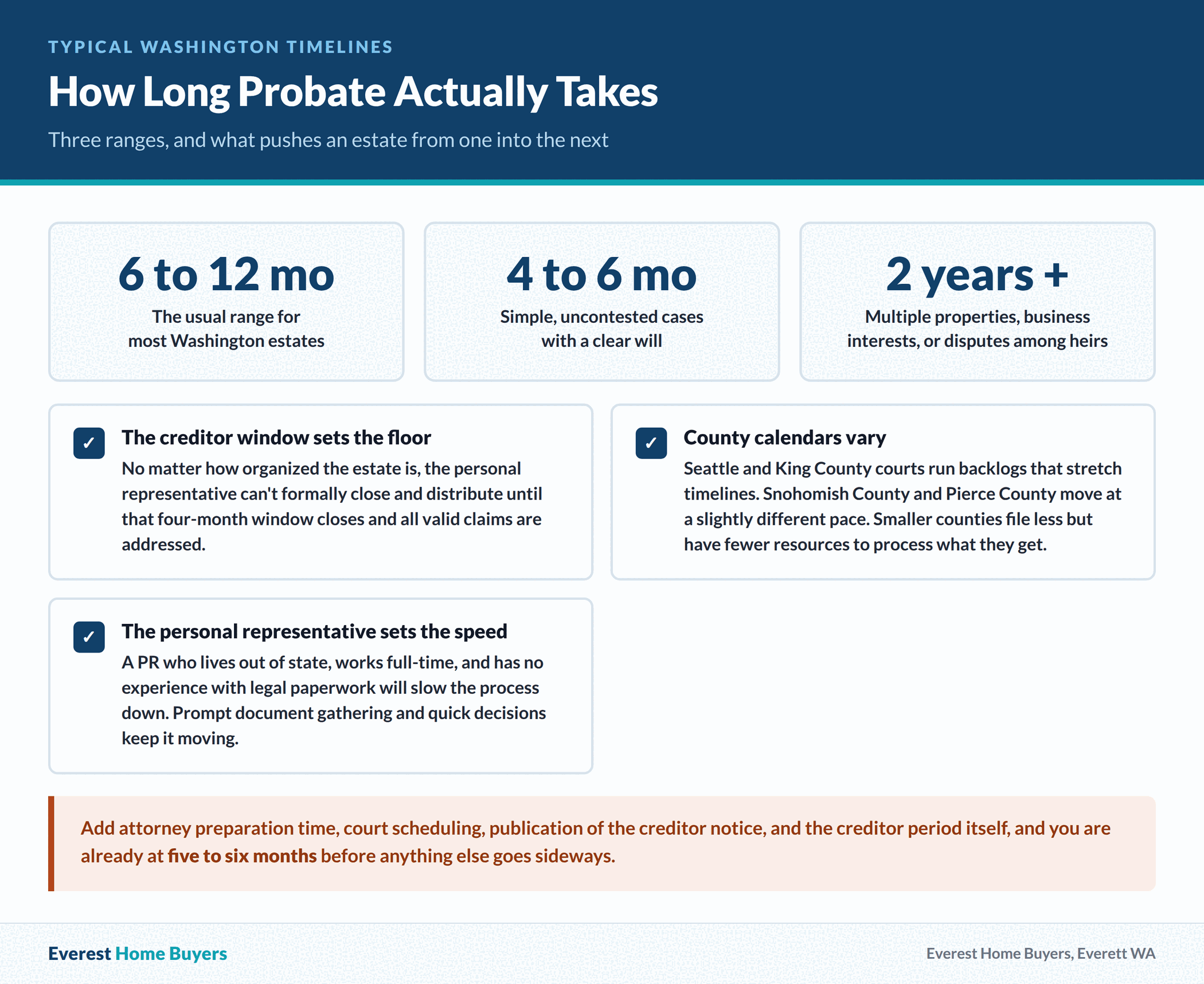
That’s not unusual at all. For most Washington estates, probate runs between 6 and 12 months. Simple, uncontested cases with a clear will can close in as few as four to six months. Complex estates with multiple properties, business interests, or disputes among heirs stretch well beyond two years.
Washington is a relatively executor-friendly state, though Seattle and King County courts run backlogs that stretch timelines. If you’re filing a petition in King County during a busy stretch, add a few weeks just for the court’s calendar. Snohomish County and Pierce County move at a slightly different pace. Smaller counties like Ferry or Wahkiakum may have fewer filings but also fewer court resources to process them.
The four-month creditor notice window is the biggest structural constraint. Once the personal representative publishes the notice to creditors, that clock starts. No matter how organized the estate is, the personal representative can’t formally close and distribute assets until that window closes and all valid creditor claims are addressed. It’s a floor, not a ceiling.
A timeline generally begins when the court appoints the personal representative, and that first step alone can take a few weeks. Add attorney preparation time, court scheduling, publication of the creditor notice, and the creditor period itself. You’re already at five to six months before anything else goes sideways.
Estates where everyone agrees and the paperwork is clean wrap up on the shorter end. Contested wills, missing heirs, tax complications, or real estate in multiple counties push the timeline out hard. A contested estate can run two to three years with no realistic end in sight. One King County estate I’m aware of involved a disputed handwritten will and three adult children with competing claims. It ran for nearly four years before a settlement was reached, and the legal fees ate a significant portion of what the estate was worth. That’s why I always tell buyers of inherited properties to ask how long probate has been open before making an offer.
What Factors Affect How Long Probate Takes in Washington State?
Sit across from me at a kitchen table and I’ll tell you what I’ve told a dozen families in Tacoma and Olympia. The biggest factor isn’t the court. It’s usually the family.
When heirs disagree on whether to sell, how to price, or who gets what personal property, everything stalls. Attorneys bill by the hour, the house sits vacant, and property taxes and insurance keep accruing (utilities don’t pause for family disputes either). I’ve watched families spend more fighting over a house than the house was worth in equity.
Beyond family dynamics, several factors move the timeline: estate size, missing heirs, contested wills, creditor disputes, and whether real estate is involved. Real estate almost always adds complexity. It needs appraisals, maintenance and insurance during the probate period, and in some cases court-supervised sale procedures.
Washington’s estate tax is another timing factor that trips people up. Washington has no state estate tax on estates under $2.193 million, based on the 2024 threshold. Estates above that amount face additional filing requirements that can slow distribution. For high-value estates in markets like Medina or Mercer Island, homes alone can push past that threshold, and the tax implications add paperwork and delay. The Washington estate tax return is due nine months after the date of death. Extensions are available, but you have to request them proactively. Missing that deadline triggers interest and penalties that come directly out of the estate.
Geography matters too. A rural estate in Okanogan County or Grays Harbor County moves differently than one in Bellevue. Court calendars in smaller counties may run longer for certain filings, or shorter. Your county clerk’s office can give you a realistic sense of current scheduling.
The personal representative’s availability is underrated as a factor. A PR who lives in another state, works full-time, and has no experience with legal paperwork will slow the process down. Prompt responses to attorney requests, document gathering, and quick decisions keep things moving. Dragging heels on any of those extends the timeline. I’ve seen estates where the PR lived in Arizona and juggled a demanding job at the same time. Every document request took two weeks to turn around, and a nine-month process stretched to eighteen months. Carrying costs on the home during those extra nine months were real money out of the beneficiaries’ pockets.
Families often overlook the condition of the property. An estate home that needs significant repairs may require contractor bids, insurance adjustments, or code compliance work before anyone can sell or transfer it. Deferred maintenance the deceased never addressed becomes the personal representative’s problem to manage, document, and disclose.
How Much Does Probate Cost in Washington State?
People walk in expecting probate to cost a few hundred dollars in filing fees. The filing fee is only the beginning.
Basic probate costs include the Superior Court filing fee of approximately $200, publication of the Notice to Creditors running $100 to $200, and miscellaneous additional expenses. For simple to moderate estates, attorney fees range from $3,500 to $12,000. For complex estates or contested matters, that ceiling climbs much higher.
Attorney fees in Washington follow a “reasonable fee” standard rather than a fixed statutory percentage. Attorney fees range from 2% to 4% of the estate’s total value. For a $500,000 estate, legal fees alone could reach $10,000 to $20,000. Families need to plan for a real number like that, not treat it as an edge case.
On top of attorney fees, the personal representative is entitled to compensation. The personal representative’s reasonable compensation generally runs from 1% to 3% of the estate value. In many family situations the PR waives this fee. When a professional fiduciary is appointed, that compensation is real money coming out of the estate before anyone inherits a dime.
If the estate qualifies, the small estate affidavit route is dramatically cheaper. The small estate affidavit process requires only minimal court fees and potentially no attorney involvement. Real property must still go through probate regardless of value. So that shortcut doesn’t help if the main asset you’re moving is a house.
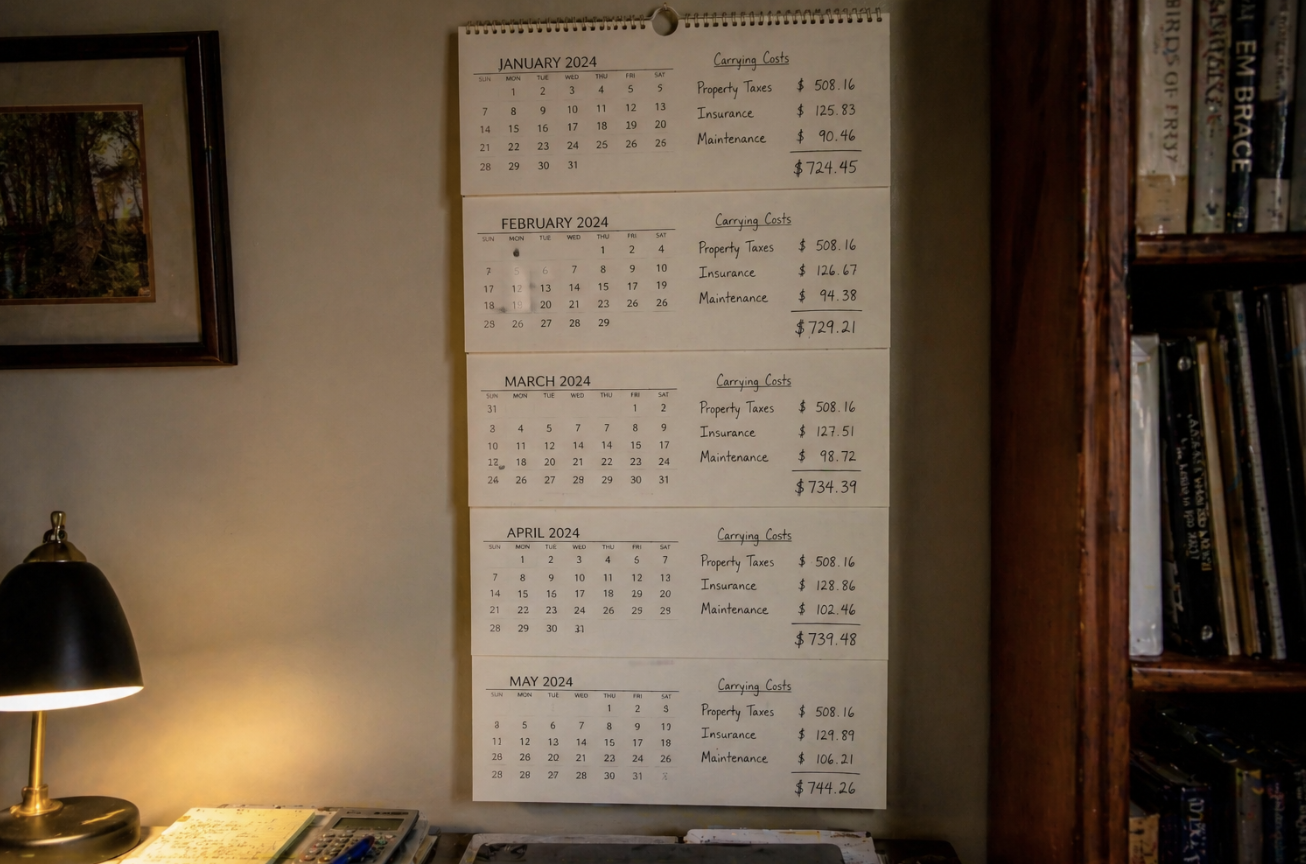
Beyond legal fees and court costs, families underestimate the carrying costs during the probate period itself. A vacant home in Washington still requires homeowner’s insurance, and many standard policies won’t cover a property that’s been vacant for more than 30 to 60 days. The estate may need to buy a vacant property rider or a separate vacant home policy, which costs more than a standard policy. Add property taxes, utility bills to keep the heat on and prevent pipe damage, lawn maintenance to avoid municipal violations, and occasional repairs. The monthly carrying cost on a mid-range estate home can easily run $1,500 to $2,500 per month or more.
Washington’s estate tax adds another layer for larger estates. Washington has the highest top estate tax rate in the nation at 20%, with graduated rates from 10% to 20% and a million-dollar exemption based on the 2024 threshold. Families who inherit a home in Seattle or Bellevue while also inheriting other assets may face state estate tax filings on top of the standard probate costs.
What Are the Most Common Probate Mistakes in Washington State?
Waiting too long to open probate is the single most expensive mistake families make.
Every month the estate sits without a formally appointed personal representative is a month of carrying costs: property taxes, homeowner’s insurance, utilities, and potential liability if someone gets injured on a vacant property. The median home price in Washington was $607,813 as of July 2026, according to Redfin. Carrying costs on a mid-range property add up fast against a number like that.
The second common mistake is misunderstanding what the personal representative can and can’t do. Self-dealing is a breach of fiduciary duty in Washington. Selling the family home to yourself at a friendly price is still a breach, even if the other heirs were fine with it at the time. Courts take that seriously, and so do beneficiaries who later feel shortchanged. A personal representative who buys estate property has to show the transaction was at fair market value and that all beneficiaries got proper written notice, not a phone call. Skipping that step, even with good intentions, can get the sale unwound by the court, or leave the PR personally liable for the difference.
Third: ignoring the creditor notice requirement. Some families assume that because they know all of dad’s debts, they don’t need to publish the notice. That’s wrong. The formal creditor notice process limits the window during which creditors can make claims. Skip it and creditors may have longer to come after the estate, which can create problems years after distribution.
Fourth: failing to get nonintervention powers when they’re available. The difference between administering an estate with and without those powers is enormous in time and legal fees. Obtaining nonintervention powers is the single most important strategic objective for a personal representative in Washington probate. Those powers let the PR administer the estate, including the sale of real estate, without ongoing court supervision, approval, or intervention.
Fifth, and less discussed: distributing assets too early. Personal representatives eager to wrap things up sometimes distribute the bulk of the estate before all creditor claims are resolved. If a valid creditor claim surfaces after distribution, the PR may be personally responsible for satisfying it. Holding back a reserve until the creditor period fully closes is standard practice for a reason.
How to Speed Up the Probate Process in Washington State
Filing the petition promptly after death is the lever most families don’t use. Grief gets in the way, and nobody is thinking like an administrator. Every week between death and the petition filing is a week added to the far end of the timeline.
Most wills are admitted quickly under RCW 11.20.020, and administration begins soon after filing. The court’s piece can move fast once the paperwork is in. What slows things down is families waiting weeks or months to even hire an attorney (grief and logistics collide badly here).
Getting organized before the first attorney meeting saves real money. Bring the original will, a copy of the deed to any real property, a list of known accounts and debts, and the death certificate. Attorneys bill for time spent tracking down information the family could have gathered, so every missing document becomes a fee you’re paying someone else to find. If the deceased had a safe deposit box, locate the key and find out which bank holds it. Vehicles need their titles. Outstanding mortgages need their most recent statements. That level of preparation can shave hours off early attorney meetings and hundreds of dollars off the first invoice.
Pursuing nonintervention powers from the start removes the need to go back to court every time the estate needs to act. Nonintervention powers under RCW 11.68 let the personal representative administer the estate without ongoing court supervision, including selling real property. The PR signs the purchase agreement, closes at a title company, and reports the sale in the final accounting. No motions, no hearings, no court approval order.
Choosing a direct buyer for the real estate, rather than listing on the open market, also compresses the timeline. The median days on the market for a Washington home was 31 days in July 2026. That’s weeks before an offer, then another 30 to 45 days for a conventional financing close. A cash buyer can close in as little as one to two weeks. When the estate is paying insurance and taxes on a vacant property, that difference matters in real dollars. On a home with $2,000 per month in carrying costs, shaving six weeks off the sale timeline saves the estate $3,000 before you account for any price negotiation.
Working with a buyer like Everest Home Buyers means someone on the other side already understands probate timelines. We can work with the personal representative directly. A court schedule won’t scare us off, and neither will a leaky roof we find during inspection.
Can You Sell a House Before Probate Is Finished in Washington State?
A substantial sum. That’s roughly what the median Washington home is worth right now. For most families, the house is the estate. Whether you can sell it before probate closes isn’t an abstract question. It’s the whole ballgame.
Many people don’t realize that property owned only by a deceased person usually can’t be sold until the probate process begins and a personal representative is appointed. You can’t sell without legal authority to do so. No authority, no sale. That authority comes from the court in the form of Letters Testamentary, also called letters testamentary.
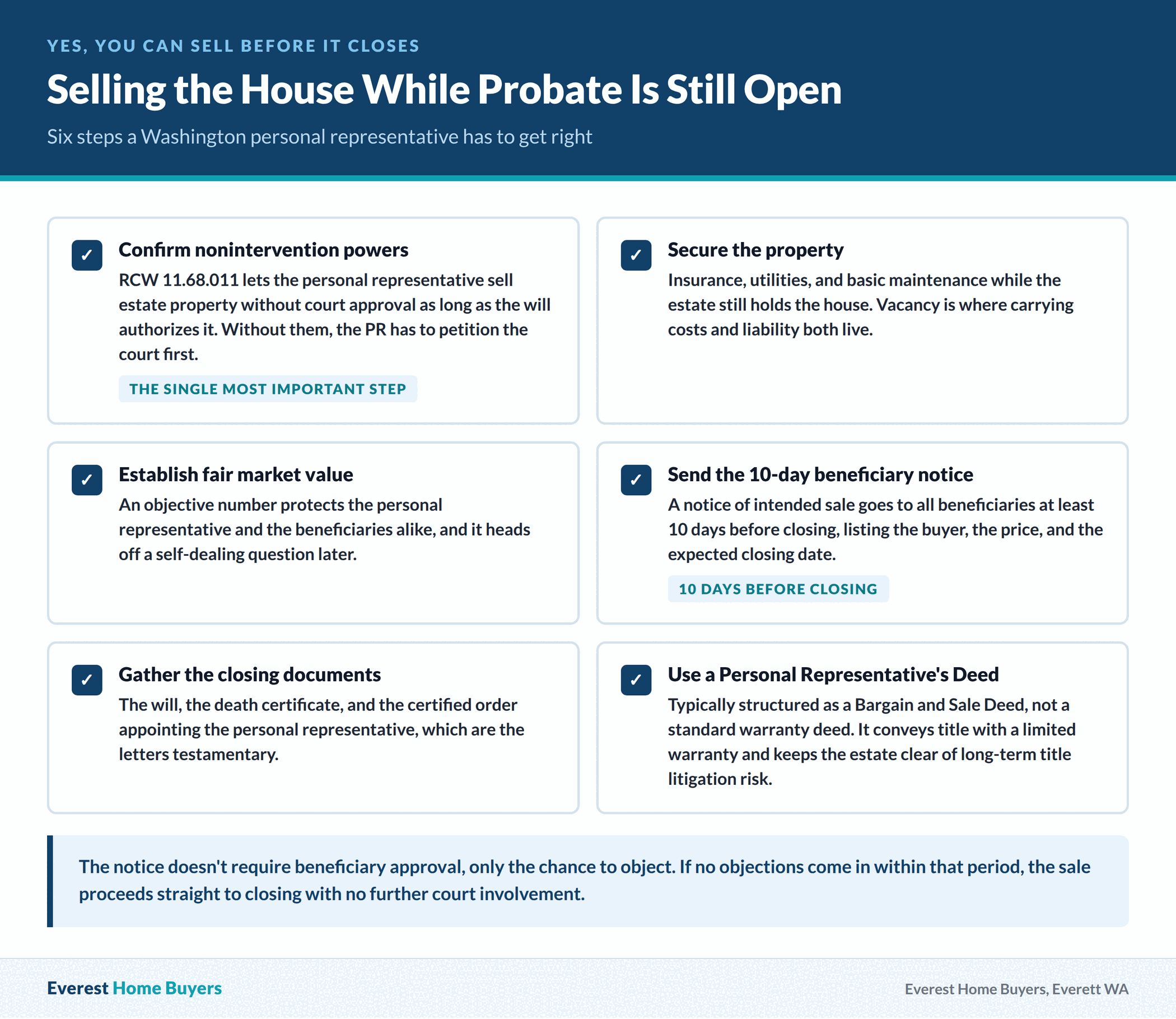
Good news on that front: selling during probate, before the estate fully closes, is absolutely possible in Washington. Selling a house during Washington probate requires personal representatives to secure the property, confirm nonintervention powers, establish fair market value, provide a 10-day notice to beneficiaries, and complete closing with proper probate documentation.
That 10-day beneficiary notice is the key procedural step most people haven’t heard of. Personal representatives must send a notice of intended sale to all beneficiaries at least 10 days before closing. If no objections come in within that period, the sale can proceed straight to closing with no further court involvement. The notice must include the basic terms of the sale: the buyer, the price, and the expected closing date. It doesn’t require beneficiary approval, only the chance to object. If a beneficiary does object, the PR may need to seek court guidance before proceeding, which can add weeks to a tight timeline.
The closing itself requires specific documentation. The closing process calls for specific probate documents: the will, the death certificate, and the certified order appointing the personal representative, which are the letters testamentary. A Personal Representative’s Deed handles the conveyance, not a standard warranty deed. Title companies that regularly handle probate transactions know exactly what to ask for, and the ones that don’t create delays. Ask upfront whether the title company has experience closing probate sales. In smaller markets like Wenatchee or Aberdeen, that experience may be less common than in King or Pierce County.
If the estate doesn’t have nonintervention powers, the personal representative must seek strict judicial approval for the sale, and that adds time and expense. The court-supervised sale process under RCW 11.56 requires petitioning the court, setting a hearing, and possibly navigating a public overbid process.
Everest Home Buyers has closed on properties mid-probate and knows exactly what documents the title company needs. If you’re a personal representative trying to sell the house before the estate fully wraps up, a conversation with buyers who’ve done this before is worth your time.
How to Avoid Probate in Washington State?
Most parents never sit down with an estate planning attorney. If yours didn’t, and they owned a home, that gap is probably what brought you here.
Avoiding probate entirely takes planning done while someone is still alive. After death, the options narrow fast. A few paths work reliably for Washington residents.
A revocable living trust is the cleanest tool. Creating one allows assets to transfer directly to beneficiaries without court involvement. The person who creates the trust stays in control of all assets during their lifetime. At death, the successor trustee steps in and distributes assets according to the trust terms. No court, no petition, no creditor notice period. For a family with a home, investment accounts, and other assets, a properly funded trust can eliminate probate entirely. That saves tens of thousands of dollars in legal fees and carrying costs, assuming somebody actually funded the trust.
Washington also allows transfer-on-death deeds for real property, sometimes called TOD deeds. The owner records the deed during their lifetime, naming who inherits the property at death. When the owner dies, the beneficiary records a simple affidavit and takes title. No probate required for that property. A TOD deed costs relatively little to prepare and record, typically a few hundred dollars with an attorney, and the owner can revoke or change it any time. For homeowners with a simple estate and a clear picture of who should inherit the property, it’s one of the most cost-effective planning tools available in Washington.
Joint ownership with rights of survivorship and proper beneficiary designations on accounts also bypass probate. A married couple holding the family home as joint tenants with right of survivorship doesn’t need probate for the house when one spouse dies. The survivor simply records a death certificate with the county.
In Washington, couples can also establish community property agreements, which ease the transfer of assets without probate. That tool is specific to married couples and registered domestic partners in Washington, and it can cover all community property in one document.
For smaller estates, the small estate affidavit under RCW 11.62 sidesteps full probate for personal property below the threshold. Keep in mind this doesn’t work for real estate. A house always needs a trust, a TOD deed, joint tenancy, or probate to transfer title.
When Do You Need a Probate Lawyer in Washington State?
Getting this decision wrong costs estates far more than hiring an attorney would have in the first place.
Families sometimes try to handle probate without legal help when the estate looks simple on the surface. Simple estates still trip people up. A personal representative who misses the creditor notice publication, fails to file a proper inventory, or distributes assets before resolving all claims can face personal liability. The court doesn’t excuse errors because the PR was acting in good faith.
Any time there’s real property involved, an attorney is worth the fee. For title conveyance, the personal representative must use a Personal Representative’s Deed, typically structured as a Bargain and Sale Deed. That deed matters as a risk tool because it conveys title with a limited warranty. It warrants only that the PR has the right to convey and hasn’t personally encumbered the property during their tenure. The estate stays clear of long-term title litigation risk over prior defects.
You need an attorney for contested wills, full stop. If any heir challenges the validity of the will or the conduct of the personal representative, you’re in litigation. Trying to navigate that without counsel is not a cost-saving move.
Estates subject to Washington’s state estate tax need an attorney who understands both the probate filings and the tax return requirements. The personal representative may be responsible for filing a Washington estate tax return. Errors there can trigger audits and penalties that come out of the estate before distribution.
Even for straightforward estates, a single consultation with a probate attorney can catch problems early. Most attorneys offer initial consultations at a fixed cost, and many probate attorneys across King County, Snohomish County, and Pierce County offer flat-fee arrangements for standard probate matters. Get clarity on the fee structure before you sign anything. A flat fee gives the personal representative cost certainty and removes the incentive for the attorney to let the process drag. For a standard uncontested estate with one piece of real property, flat-fee probate representation in Washington runs $3,500 to $6,000 depending on complexity and location.
How an Estate Planning and Settlement Lawyer Can Help with Probate in Washington State
Some families push back on this: “An attorney just makes everything slower and more expensive.” That’s occasionally true of the wrong attorney. A good probate attorney does the opposite.
The personal representative carries real legal responsibility during probate. Once the personal representative has correctly distributed assets, they must get court approval before the estate can officially close. Every step of that process has deadlines, filing requirements, and documentation standards. An attorney tracks all of it so the PR doesn’t have to.
An estate planning attorney who also handles probate settlement can look at the estate and sort out which assets are subject to probate and which aren’t. The same lawyer can determine whether nonintervention powers are available and map the fastest compliant path to closing. That’s not overhead. That’s strategy.
For estates with real estate, an attorney makes sure the title transfer is clean. Buyers, title companies, and lenders scrutinize probate deeds carefully. A deed executed incorrectly can cloud title and create problems for the beneficiary years after the estate closes. Getting it right the first time protects everyone downstream. A beneficiary who later tries to refinance or sell the inherited property may find a title defect that traces back to a probate deed executed without proper authority or documentation. I’ve watched that delay closings by months. Clearing the defect can cost more than the original attorney fees would have.
A few years back, a family came to me after the estate of their mother in Federal Way had already been partially distributed. The personal representative had sold a vehicle and used the proceeds without reporting it or getting proper authorization. One of the siblings caught it during the final accounting. What would have been a clean close turned into a months-long dispute that cost more in legal fees than the vehicle was worth. An attorney reviewing things from the start would have flagged that before it happened.
Estate planning, done while someone is still alive, is where attorneys add the most value at the lowest cost. A properly drafted will with nonintervention powers language does most of the work. Add a revocable living trust if the estate warrants it, a community property agreement for married couples, and TOD designations on accounts and real estate. That combination eliminates most of what makes probate slow and expensive. The cost of that planning is a fraction of what probate costs when nothing has been set up.
If you’re a personal representative looking for guidance on where to start, Washington Law Help has plain-language resources on probate and settling an estate. For the legal specifics of your situation, a licensed Washington probate attorney is the right call.
Frequently Asked Questions
What Is the Average Cost of Probate in Washington State?
Basic probate costs include the Superior Court filing fee of approximately $200, publication of the creditor notice running $100 to $200, and miscellaneous costs of $50 or more. Attorney fees typically range from $3,500 to $12,000 for simple to moderate estates. On top of that, the personal representative may also be entitled to compensation of roughly 1% to 3% of the estate’s total value. For large estates, state estate tax filings add further expense. Your attorney can give you a realistic estimate once they review the estate’s assets.
Can You Sell a House Before It Goes Into Probate?
No. A house titled solely in the deceased person’s name can’t legally be sold until probate has been opened. The Superior Court has to appoint a personal representative with legal authority to act on behalf of the estate. You usually cannot sell a house owned only by a deceased person until probate begins and a Washington Superior Court appoints a personal representative with legal authority in the form of letters testamentary. Once that authority is granted, the sale can proceed during probate, before the estate fully closes, as long as the required beneficiary notice and documentation steps are followed.
How Long Do You Have to Transfer Property After Death in Washington State?
Washington doesn’t set a hard deadline for how quickly an estate must be opened or closed, but delays carry real costs. Washington law gives creditors four months to submit claims against the estate once the creditor notice has been published. That clock doesn’t start until the notice goes out, so waiting to open probate extends the entire timeline. Carrying costs on a vacant property, including insurance, taxes, and maintenance, accrue the entire time. Most estate attorneys recommend opening probate within a few weeks of death to avoid compounding delays.
Why Avoid Probate in Washington State?
Probate is public, time-consuming, and more expensive than most families expect. Every filing becomes part of the court record anyone can read. The process typically runs six months to a year even for clean estates, and all those months cost money in attorney fees, carrying costs on real property, and personal representative time. For families with Washington real estate, a revocable living trust or transfer-on-death deed can transfer the home directly to heirs without any court involvement, which is faster, cheaper, and private.
None of this has to drag on for years, but it does take attention, organization, and the right people in your corner. If you’re a personal representative trying to figure out what to do with a house, we’re happy to talk through your options. Same goes for a family member who just wants the estate settled so everyone can move forward. Everest Home Buyers buys houses in all conditions, during or after probate, across Washington State. We work with personal representatives, probate attorneys, and families directly, and we know what the process looks like from the inside. If you’d like a no-pressure offer, or just want to ask a few questions before you decide anything, reach out. No obligation, no hard sell. Just a straight conversation with someone who’s been through this hundreds of times and wants to help you land on the right path.
Probate Home Sales Across Everett and Snohomish County
Most of the estates we work with sit within an hour of Everett. The median Everett home sold for $594,702 in July 2026 according to Redfin, which puts a real number on what a vacant estate house is carrying every month it waits on the court. If the estate needs cash home buyers in Everett, a company that buys homes in Marysville, or investor home buyers in Bothell, the city page covers what we do there. Personal representatives further out can check our service area across Washington.
Talk It Through Before You Commit to Anything
Nothing has to be decided while the estate is still open. The Everest Home Buyers team has closed on houses mid-probate many times over, and we know what a title company will ask a personal representative for. If you want to see how our process works first, read that, or check out other frequent questions personal representatives ask us. When you’re ready, contact us and tell us where the estate stands. The form below reaches us directly, with no obligation on your side.