
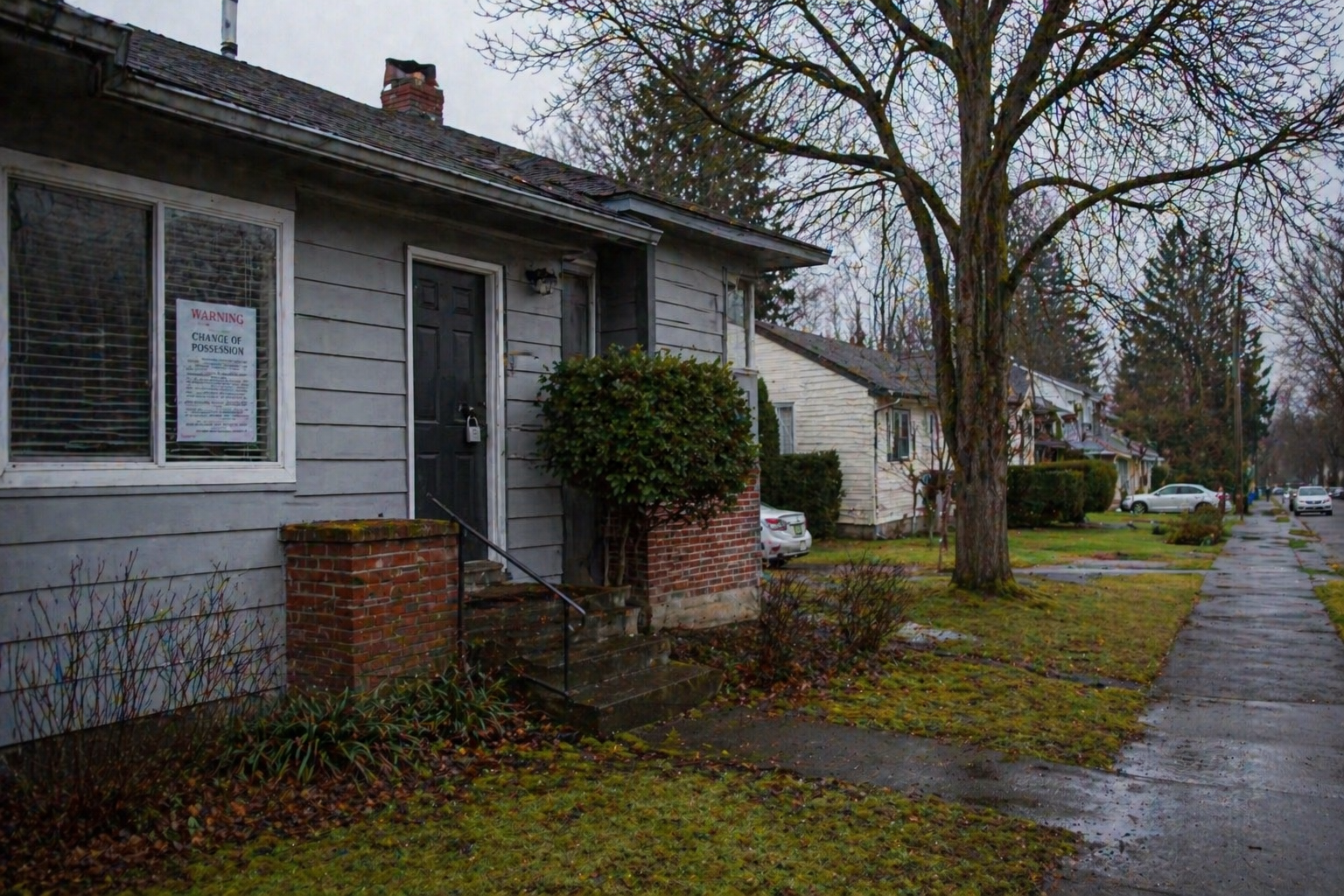
Most homeowners in Washington picture foreclosure as a slow court battle. A judge bangs a gavel. The keys disappear. Reality runs on a much tighter clock than that, and your window to act can close inside days rather than weeks. Sometimes fewer than five.
What’s on this page
- How Washington State’s Foreclosure Timeline Works
- Nonjudicial Mortgage Foreclosure Vs. Property Tax Foreclosure in Washington State
- How the Foreclosure Fairness Act and Mediation Program Can Help You
- What Are Your Alternatives to Foreclosure in Washington State?
- What Reinstatement and Bankruptcy Mean for Stopping Foreclosure
- What Happens on Foreclosure Sale Day in Washington State
- What Happens After Foreclosure in Washington State and What You Can Still Do
- Local Legal Assistance and Resources for Washington State Homeowners
- Frequently Asked Questions
- Foreclosure Help Across Everett and Snohomish County
- Talk Through Your Options Before the Sale Date
How Washington State’s Foreclosure Timeline Works
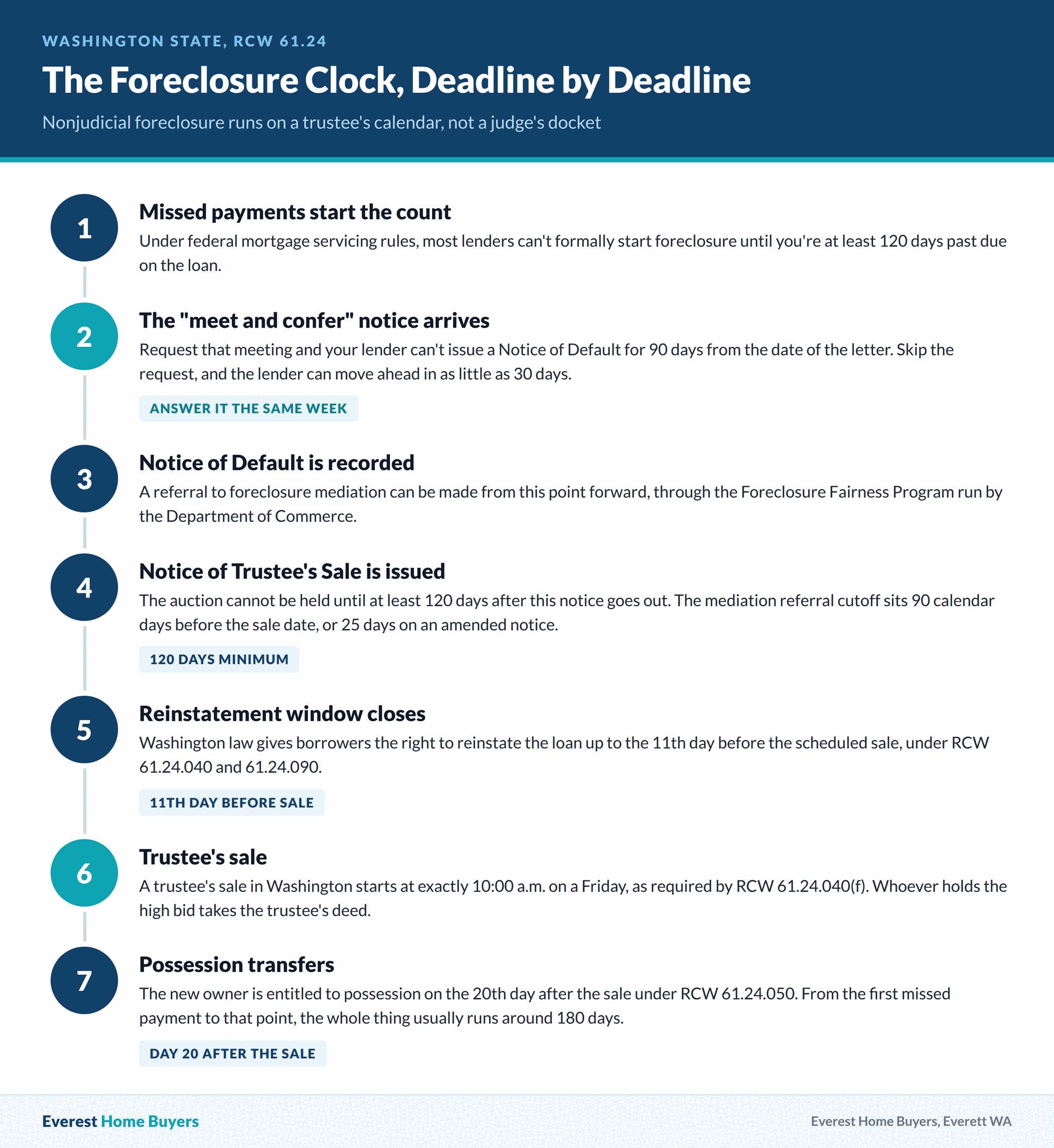
Foreclosure here doesn’t unfold in a courtroom. Washington is a non-judicial foreclosure state. A trustee runs the whole process under the authority of your deed of trust, and no judge ever signs off on any of it. Your lender has to send a “meet and confer” notice first. Request that meeting and your lender can’t issue a Notice of Default for 90 days from the date of the letter. Skip the meeting request, and the lender can move ahead in as little as 30 days. Once the Notice of Default is recorded, the trustee issues a Notice of Trustee’s Sale. The auction can’t be held until at least 120 days after that notice goes out. From the first missed payment to the auction block, the whole thing usually runs around 180 days. Formal notice requirements alone eat at least 120 of those days. Nobody mails you a schedule of those dates, so you have to track them yourself. That stretch is where a homeowner still has room to negotiate.
A few years back, I worked with a family in Kenmore. They had moved their mother into assisted living and figured they had months to sort out the house. Then the Notice of Trustee’s Sale showed up on a Tuesday, already recorded and taped to the front door. Their window had shrunk to weeks. Every day they waited cost them real negotiating room. Reading that “meet and confer” letter carefully, and answering it the same week, would have bought them a lot more time.
Nonjudicial Mortgage Foreclosure Vs. Property Tax Foreclosure in Washington State
The type of debt driving your foreclosure changes almost everything about how you should respond. That one distinction shapes what happens next.
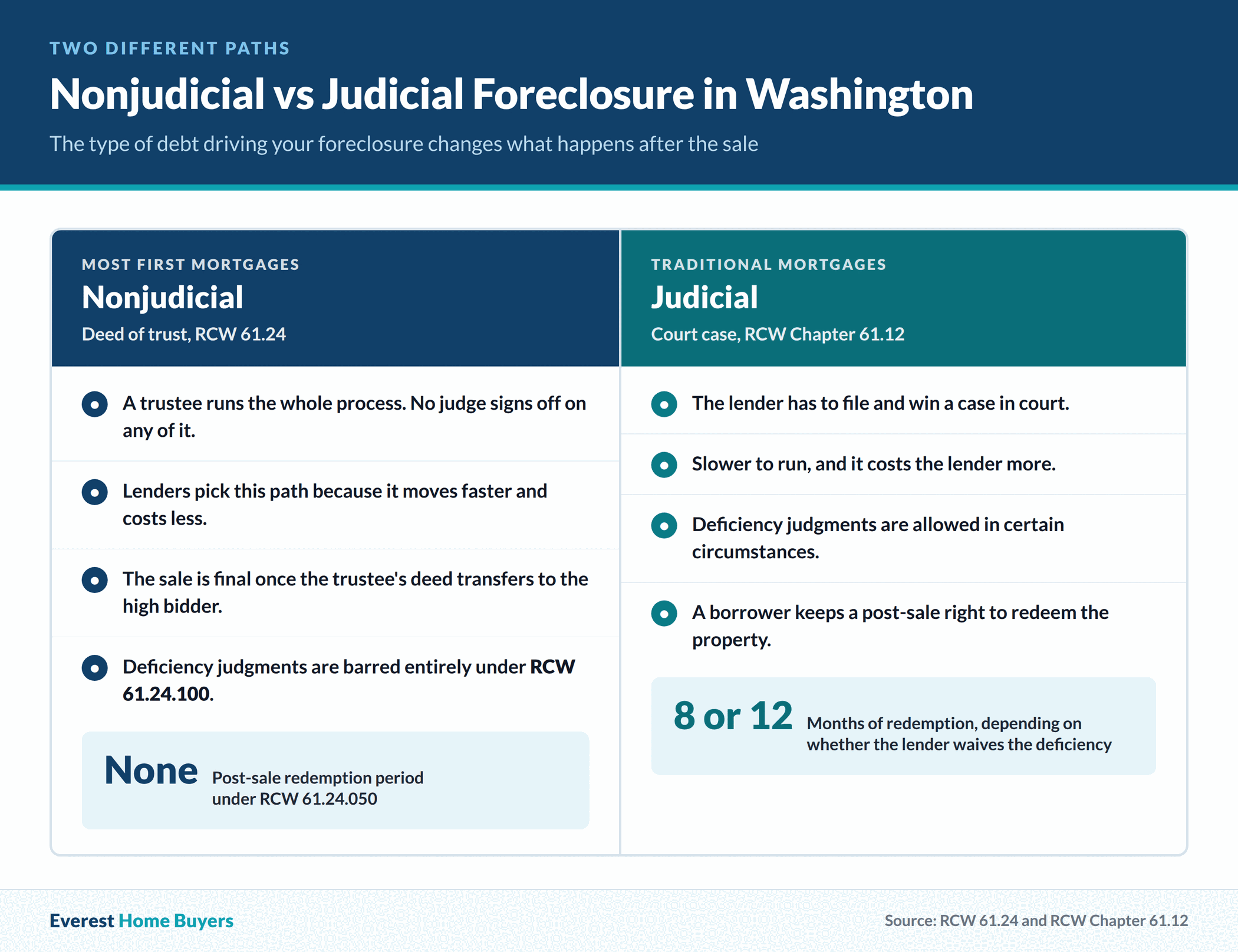
Most first mortgage foreclosures in Washington go nonjudicial, governed by the Washington Deeds of Trust Act, RCW 61.24. Lenders pick this path because it moves faster and costs less than filing a court case. A trustee runs the auction. The sale is final once the trustee’s deed transfers to the high bidder, and a borrower gets no post-sale redemption period under a nonjudicial process (RCW 61.24.050). Anyone holding a traditional mortgage instead of a deed of trust sits in a different spot. Their lender has to foreclose judicially under RCW Chapter 61.12. That route runs slower and costs the lender more. It also allows deficiency judgments in certain circumstances, and it carries a post-sale redemption period of either eight months or one year, depending on whether the lender waives the deficiency. On the nonjudicial side, Washington law bars deficiency judgments entirely (RCW 61.24.100). Your lender can’t come after you personally for the gap between the sale price and your loan balance. For a distressed seller, that is real relief.
How the Foreclosure Fairness Act and Mediation Program Can Help You
Washington’s foreclosure mediation program is the most underused tool a borrower has. Too many people hear about it a week too late.
The Washington State Foreclosure Fairness Program came out of the 2011 Foreclosure Fairness Act. The Washington State Department of Commerce runs it. Homeowners get free housing counseling plus the right to request mediation with their lender, and a lender has to tell you those services exist before they can move forward. A referral to mediation can be made from the time the Notice of Default is issued, up until 90 calendar days before the scheduled sale date. On any amended notice, the cutoff sits 25 calendar days before that date. Senate Bill 5686, signed in 2025, expanded the program, funded it permanently, and widened who qualifies. Your county clerk’s office can point you toward a housing counselor at no cost. So can the Department of Commerce at commerce.wa.gov.
What Are Your Alternatives to Foreclosure in Washington State?
“I’ve already missed three payments. It’s too late to do anything.” Sellers tell me some version of that most weeks. It’s almost never true.
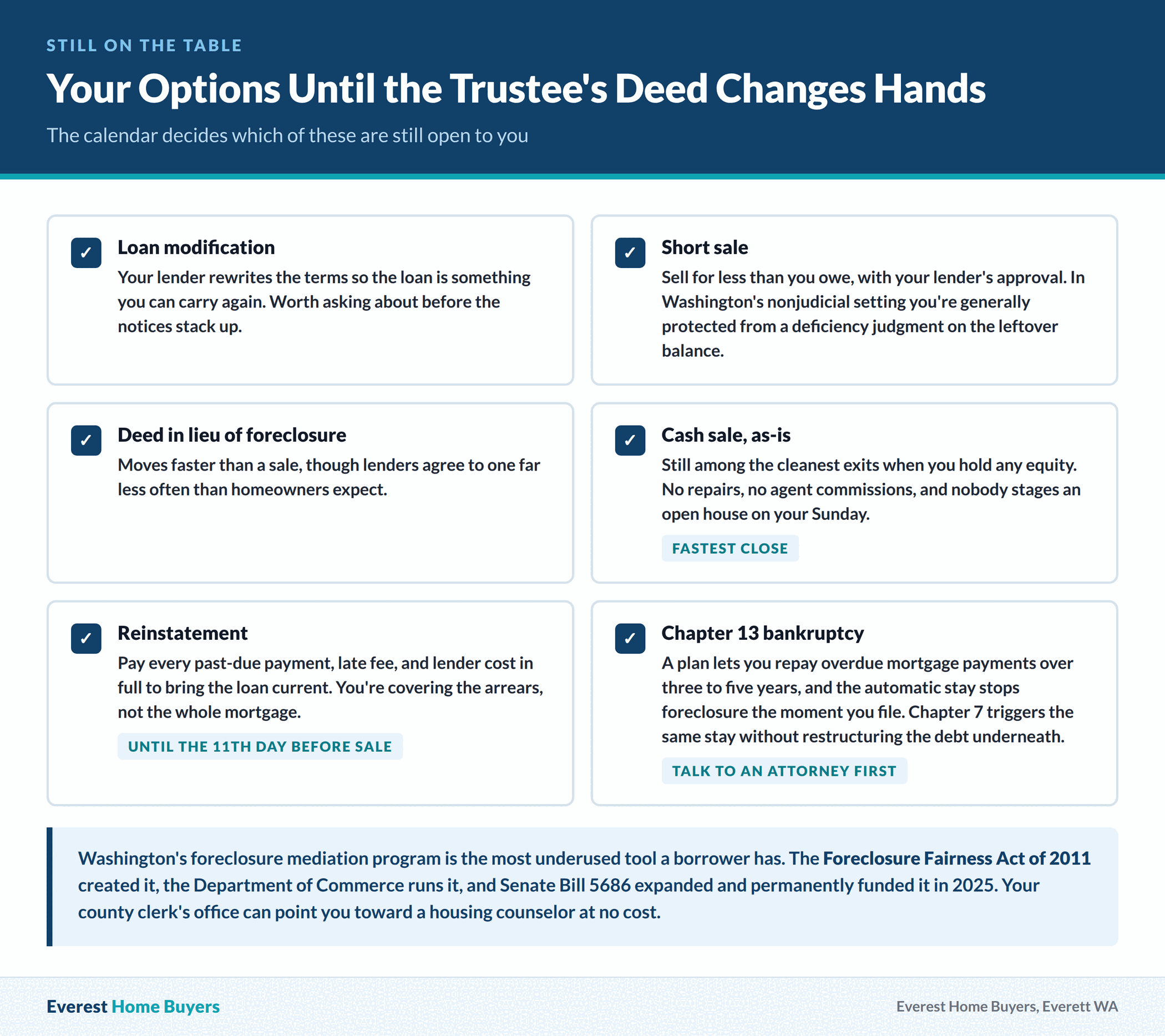
Loan modifications, short sales, a deed in lieu of foreclosure, and a straight cash sale all stay on the table until the trustee’s deed changes hands. Each path has a different closing process, and the calendar decides which ones are still open to you. A short sale lets you sell for less than you owe, with your lender’s approval. In Washington’s nonjudicial setting you’re generally protected from a deficiency judgment on the leftover balance. A deed in lieu moves faster, though lenders agree to one far less often. Selling outright is still among the cleanest exits when you hold any equity. As of July 2026, the statewide median home sale price in Washington sat at $607,813 according to Redfin, with homes spending a median of 31 days on market. A seller racing an auction date doesn’t have those weeks to spare. That’s before any inspection delays. Teams like Everest Home Buyers buy houses as-is. You skip the repairs and the agent commissions, and nobody stages an open house on your Sunday.
What Reinstatement and Bankruptcy Mean for Stopping Foreclosure
Washington law gives borrowers the right to reinstate a loan up until the 11th day before the scheduled sale (RCW 61.24.040 and 61.24.090). Reinstatement means paying every past-due payment, late fee, and lender cost in full to bring the loan current. You’re covering the arrears, not the whole mortgage. When reinstatement is out of financial reach, Chapter 13 bankruptcy is worth a serious conversation with an attorney. A Chapter 13 plan lets you repay overdue mortgage payments over three to five years. The automatic stay stops foreclosure the moment you file. Chapter 7 triggers that same stay, but it doesn’t restructure debt the way Chapter 13 does. So it usually delays foreclosure instead of resolving the default underneath it. Both routes leave a mark on your credit and your future borrowing. Getting legal help early is the step that actually changes outcomes.
What Happens on Foreclosure Sale Day in Washington State
A trustee’s sale in Washington starts at exactly 10:00 a.m. on a Friday, as required by RCW 61.24.040(f).
During the auction, the lender opens with a bid covering the outstanding debt, and third-party bidders can compete against it. Bidders show up at the sale with certified funds ready to go. Whoever holds the high bid takes the trustee’s deed. Once that deed transfers, the sale is final. No statutory right to redeem the property survives it, and the former owner’s interest is wiped out. Properties in Tacoma, Everett, and Spokane often revert to the lender when nobody meets the opening bid, which lands them on the lender’s books as REO. I’ve watched that happen more than once. Either way, the prior homeowner’s right to the property ends when the gavel comes down.
What Happens After Foreclosure in Washington State and What You Can Still Do
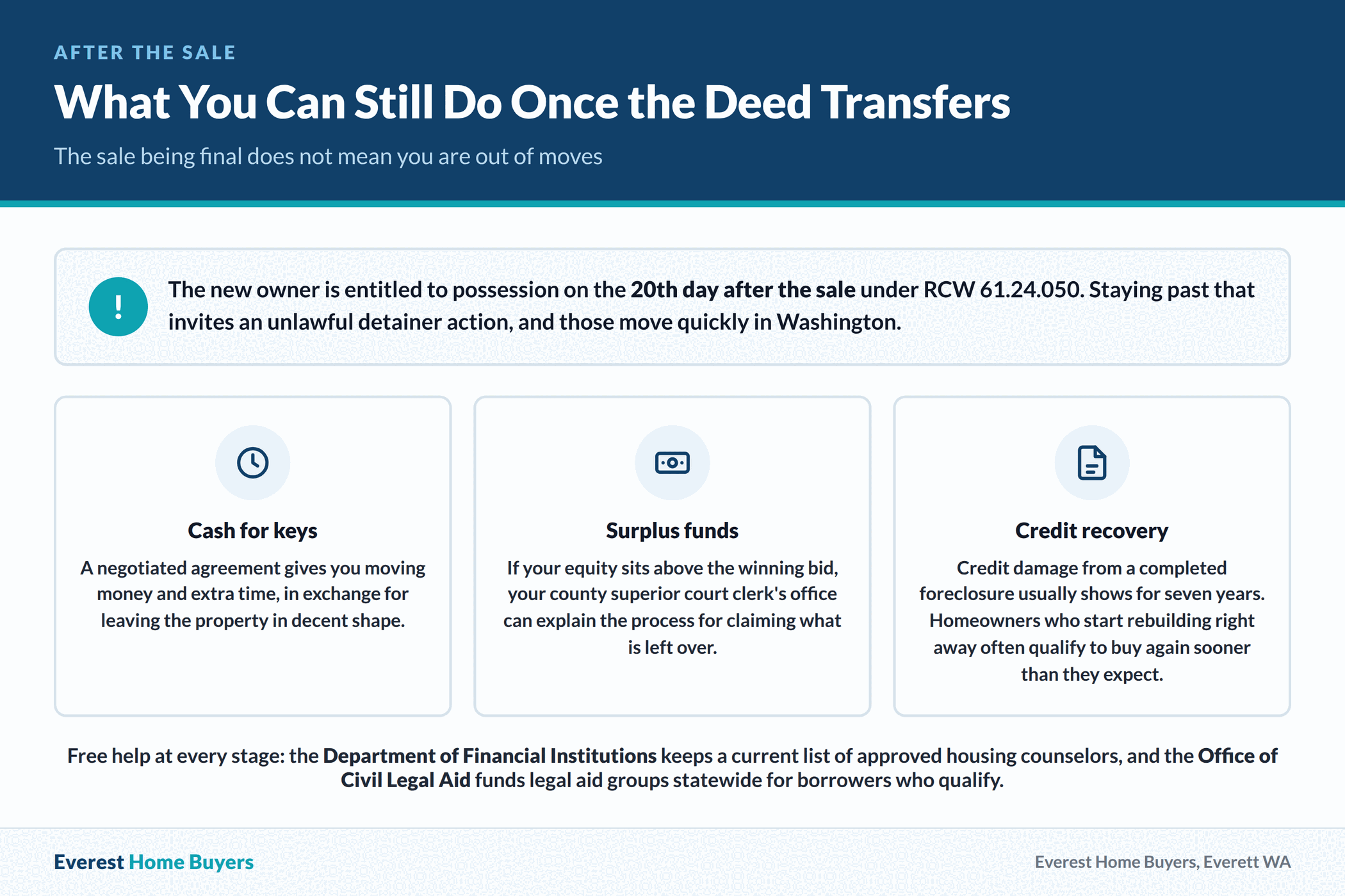
Once the trustee’s deed is issued, the new owner is entitled to possession on the 20th day after the sale under RCW 61.24.050. Staying past that invites an unlawful detainer action, and those move quickly in Washington. You can still negotiate. A cash-for-keys agreement gives you moving money and extra time in exchange for leaving the property in decent shape. If your equity sits above the winning bid, your county superior court clerk’s office can explain the process for claiming surplus funds. Credit damage from a completed foreclosure usually shows on your report for seven years. Homeowners who start rebuilding right away often qualify to buy again sooner than they expect.
Another seller, this one in Redmond, took a job transfer and had five weeks before they needed to be in Denver. Their timeline ruled out a traditional listing. We closed in under three weeks, which let them focus on the move instead of an open house schedule. Situations like that are why Everest Home Buyers exists, to give homeowners a real option when the calendar is the enemy.
Local Legal Assistance and Resources for Washington State Homeowners
Free help exists at every stage. The Washington State Department of Financial Institutions keeps a current list of approved housing counselors and explains how the mediation referral works. The Office of Civil Legal Aid (OCLA) funds legal aid groups across the state that work with homeowners facing foreclosure, and those services are free for borrowers who qualify. A counselor can also tell you whether mediation is still on the table for you. Homeowners in King County, Spokane County, or Pierce County can also use their local bar association’s lawyer referral service, which connects you with foreclosure attorneys for low-cost first consultations. Past the sale date, a HUD-approved counselor can walk you through surplus funds, notices to vacate, and credit recovery at no charge. If a quick, clean sale fits your situation better, reaching out to Everest Home Buyers costs nothing to explore.
Frequently Asked Questions
How Long Does Foreclosure Take in Washington State?
The process from your first missed payment to the auction usually runs about 180 days. It can stretch longer depending on how fast your lender moves and whether mediation gets requested. Statutory notice periods require a minimum of 120 days of formal notices before any sale can happen. Request the “meet and confer” meeting your lender is required to offer, and that alone pushes the Notice of Default out 90 days from their letter.
Can You Get Your House Back After Foreclosure in Washington State?
After a nonjudicial trustee’s sale, which covers the vast majority of foreclosures in Washington, you get no post-sale redemption period. Once the trustee’s deed transfers to the high bidder, your ownership interest is gone. The sale is final under RCW 61.24.050. A foreclosure that went through the rarer judicial process works differently. A redemption period of eight months or one year may apply there, depending on whether the lender waived the right to a deficiency judgment.
What Is the 120-day Rule for Foreclosure?
Under federal mortgage servicing rules, most lenders can’t formally start the foreclosure process until you’re at least 120 days past due on the loan. Washington’s statutory notice timeline stacks on top of that. Once the Notice of Trustee’s Sale is recorded, at least 120 more days have to pass before the auction can be held. Those two 120-day windows are separate. Your county housing counselor can map exactly where you sit in the sequence.
Where Can You Live After a Foreclosure?
Renting is the common path, and it’s more open than people fear. Some landlords weigh rental history and income more heavily than a credit score. That holds especially true in Spokane, Tacoma, and Yakima, where rental inventory runs broader. A completed foreclosure sits on your credit for up to seven years. Rebuilding starts immediately, with on-time rent payments and every other account kept current.
Wherever you are in this, whether the foreclosure sale already happened or your first notice just landed, we’re glad to help you think it through. No pressure and no obligation. Just a straight conversation about the options in front of you.
Foreclosure Help Across Everett and Snohomish County
Everett is home base for us, and it’s where most of these calls start. The median Everett home sold for $594,702 in July 2026 according to Redfin, down 1.2 percent from a year earlier. That is real equity sitting inside a house a trustee’s sale can wipe out on a single Friday morning. We buy in the surrounding towns too, so if you’re looking for cash home buyers in Everett, a company that buys homes in Marysville, or investor home buyers in Lynnwood, start with the page for your city. Our full service area across Washington is worth a look when your town isn’t on that list.
Talk Through Your Options Before the Sale Date
You don’t owe anyone a decision today. The Everest Home Buyers team has worked with homeowners at every stage of this, from a first missed payment to the week after a trustee’s deed recorded. Some of them sold to us. Plenty of them didn’t, and went to a housing counselor or a mediation referral instead. If you want to see how our process works before you commit to anything, read that first, or check out other frequent questions we hear from sellers in your spot. When you’re ready, contact us and tell us where you sit in the timeline. The form below reaches us directly, and there’s no obligation attached to it.