
Divorce doesn’t pause for the real estate market. A mortgage still comes due on the first. The house still needs a decision, and two people who can barely agree on dinner suddenly own the most valuable asset either of them has ever held. Selling a house during a divorce in Washington State ranks among the harder things you can walk through, and not just emotionally. Legal mechanics, community property rules, tax questions, and raw market timing all have to line up at the same moment your personal life is falling apart. The calendar doesn’t care about any of it.
I’ve bought hundreds of houses across this state, from Tacoma’s Hilltop neighborhood out to the suburbs of Spokane Valley. Calls from divorcing couples follow a pattern I recognize within about ninety seconds. One spouse wants to sell fast and move on. The other wants to stay, or at least stall. Both are exhausted. Neither one wants to be on the phone with me. Getting the house handled cleanly frees both of you to start over, and that’s worth doing right.
What’s on this page
- Divorce Home Sales Are Different From Every Other Sale
- Why Selling a Home During Divorce Is Different From a Standard Sale
- Washington State Laws That Govern How Marital Property Is Divided
- Do You Have a Legal Right to Sell the Property in Washington?
- What Happens to the Family Home When Divorce Is Still Pending in Washington
- How to Sell a House During a Divorce in Washington State
- How the Sale Proceeds Get Distributed Between Divorcing Spouses in Washington
- Tax Consequences of Selling a Home During Divorce in Washington
- Common Mistakes Washington Couples Make When Selling During Divorce
- Frequently Asked Questions
- Selling a Divorce Home Around Everett and Puget Sound
- When You Want a Straight Answer About the House
Divorce Home Sales Are Different From Every Other Sale
So you’ve decided to sell, and both of you agree. Now what? Most couples assume the process looks like any other listing. Hire an agent, set a price, take an offer, close in thirty days. Two co-owners and a judge’s calendar collapse that assumption fast.
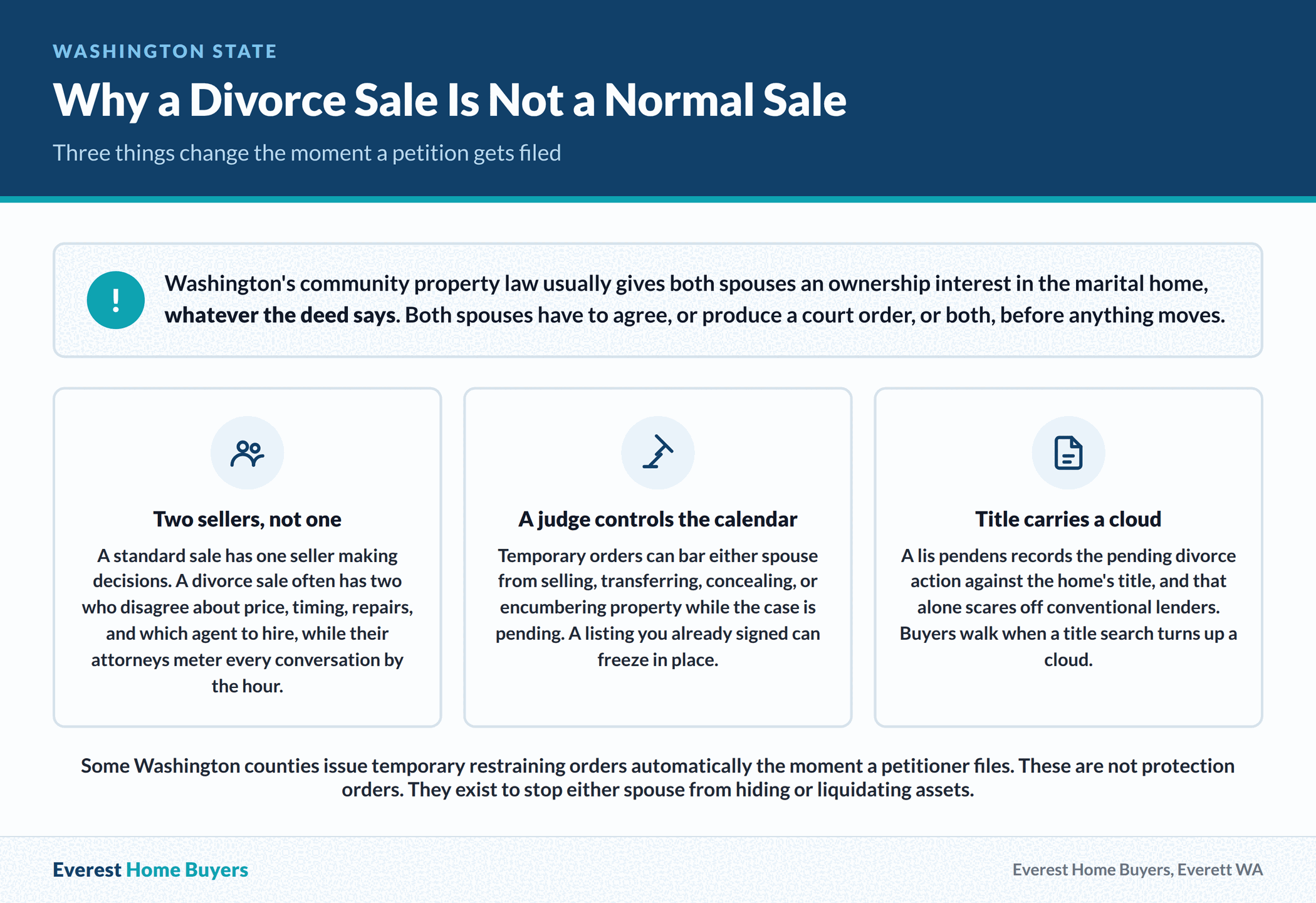
A standard home sale has one seller making decisions. A divorce sale often has two sellers who disagree about price, timing, repairs, and which agent to hire, while their attorneys meter every conversation by the hour. Washington’s community property law usually gives both spouses an ownership interest in the marital home, whatever the deed says. Both spouses have to agree, or produce a court order, or both, before anything moves.
Not long ago I walked a property in Kirkland with a spouse who wanted $80,000 in kitchen renovations before listing. A contractor came out on a Wednesday and put the estimate right around the kitchen’s true market value based on local comparables. That number stopped the argument cold. We made the case that selling as-is would net close to the same return with none of the carrying time. Waiting months on a crew bought them nothing. They took that option, the other spouse agreed, and the house closed without the renovation fight dragging into the court calendar. Expensive pre-sale improvements in a divorce almost never pencil out the way the optimistic spouse hopes they will.
As of July 2026, the median sale price for Washington State homes sat at $607,813, with properties spending a median of 31 days on the market. That’s useful context. A house priced correctly in most Western Washington markets still sells. Add disputed decisions, a lis pendens on title, or an unresolved court order, though, and that 31-day clock stops applying to you.
Why Selling a Home During Divorce Is Different From a Standard Sale
Sellers in a traditional transaction control their own timeline. A divorcing couple discovers, sometimes in the middle of a listing, that a judge controls theirs.
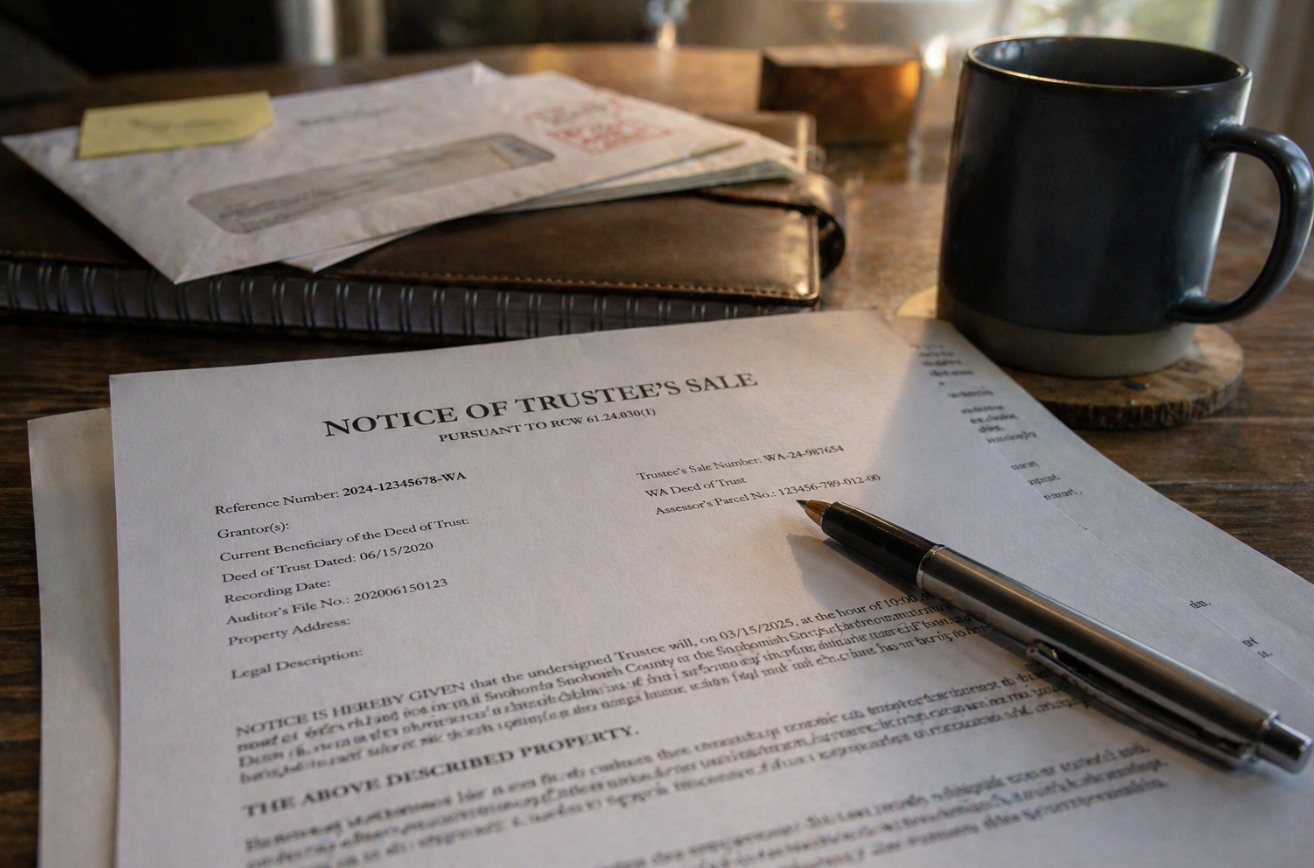
Courts often enter restraining provisions in temporary orders. Those provisions bar either spouse from selling, transferring, concealing, or encumbering property while the case is pending. A listing you already signed can freeze in place. It happens more often than you’d guess. Some Washington counties issue temporary restraining orders automatically the moment a petitioner files. These aren’t protection orders. They’re safeguards meant to stop either spouse from hiding or liquidating assets, and they typically include language that blocks transferring or selling property.
Buyers walk when a title search turns up a cloud on the property. A lis pendens records the pending divorce action against the home’s title, and that alone scares off conventional lenders. My Kirkland couple avoided the problem because they agreed early. Couples who don’t agree often watch their listing sit for months while attorneys argue in King County Superior Court.
Beneath all of it, the emotional current runs strong. Grief, anger, and fear do a lot of work in these transactions, and they blow up negotiations that would be simple between strangers. The house represents the marriage. Selling it feels like admitting the marriage is over.
Washington State Laws That Govern How Marital Property Is Divided
“Our prenuptial agreement covers the house,” a seller will tell me. Maybe. A prenuptial agreement only governs what it specifically addresses, and plenty of couples wrote theirs years before they bought the home they’re now fighting over.
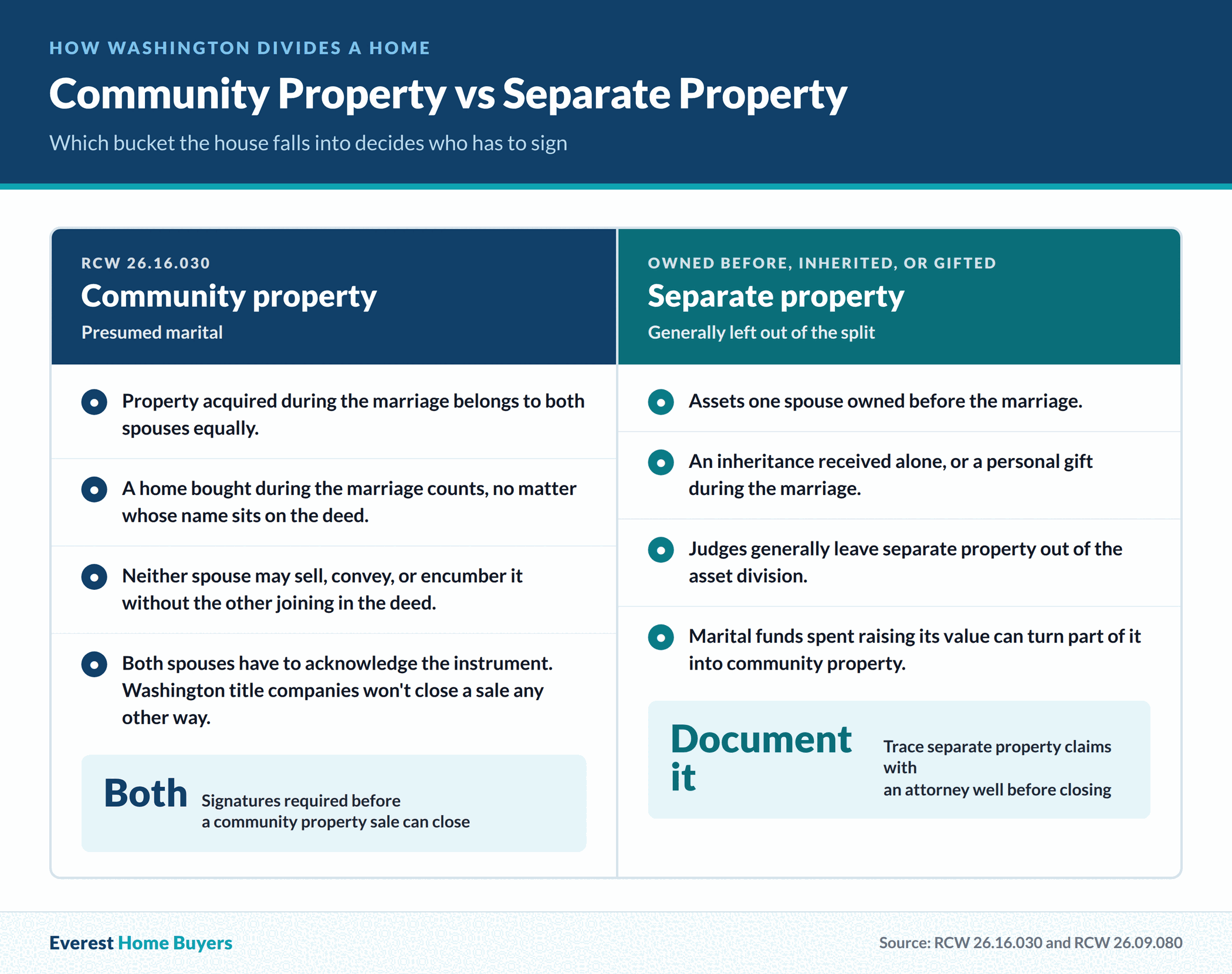
Washington presumes that property acquired during the marriage belongs to both spouses equally under RCW § 26.16.030. A home bought during the marriage counts as community property no matter whose name sits on the deed. Separate property means assets one spouse owned before the marriage, inherited alone, or received as a personal gift. Judges generally leave separate property out of the asset division. If marital funds were spent to raise the value of what started as separate property, though, part of it can become community property.
Under RCW § 26.09.080, Washington courts divide the marital home by a “just and equitable” standard, not an automatic 50/50 split. Judges weigh four statutory factors. They look at the nature of community property, at separate property holdings, at the length of the marriage, and at each spouse’s economic circumstances. Say your marriage lasted two years and you brought significant separate equity into the home when you bought it. A court might award you more than half. The statute also directs judges to consider awarding the family home to the parent with primary custody of minor children.
Your divorce attorney needs to walk through the Washington State Legislature’s RCW 26.09.080 with you directly, because the statute’s application shifts with every set of facts.
Do You Have a Legal Right to Sell the Property in Washington?
Both names don’t have to be on the deed for both of you to hold a legal stake in that house. Sitting at my kitchen table, that’s the first thing I’d tell you. It surprises people every time.
Under RCW 26.16.030, neither spouse may sell, convey, or encumber community real property without the other spouse joining in the execution of the deed. That instrument has to be acknowledged by both spouses. One spouse cannot list the house and sign the closing documents alone, whatever the mortgage says or whose name sits on the title. Washington title companies won’t let a sale close any other way.
The court backs temporary orders with the full force of law. Once entered, both parties must comply even though the orders aren’t final. Ignoring them invites court intervention. Judges have long memories about that kind of thing. Selling a property in violation of a temporary restraining order isn’t only a civil matter. A judge can treat it as contempt.
If both spouses genuinely agree to sell, that cooperative posture is the fastest path through this. A jointly signed listing agreement, written instructions to the title company, and a divorce decree or settlement agreement that spells out the split will remove most of the friction. When you can’t get there, a judge can order the sale. That process adds months and legal fees to both sides of the ledger. I’ve watched it stretch well past a year.
What Happens to the Family Home When Divorce Is Still Pending in Washington
Judges do not like surprises involving real estate.
During a divorce case winding through the court system, the home sits in a kind of legal suspended animation. Neither party can act on it alone. Courts can issue temporary orders that work as an immediate freeze on selling major assets, real estate included. A judge wants the marital estate preserved in roughly the condition it was in when the petition was filed. Mortgage payments, repairs, or improvements made during this stretch can all become points of dispute later. Ask your attorney what yours actually says.
When someone files for divorce in Washington, an Automatic Financial Restraining Order often lands right along with it. Most people don’t see that coming. This order is standard practice in several Washington counties, and it exists to keep both parties financially stable while the divorce process runs.
Is there a path to selling before the case is resolved? Yes, with a court order authorizing the sale or with both spouses’ written agreement. Buyers and lenders will want that documentation in hand. A cash buyer is often more flexible about title complexity than a buyer using conventional financing, and I’ve watched transactions collapse over exactly that. This is one reason divorcing sellers sometimes consider working with a direct buyer like Everest Home Buyers instead of listing on the open market while the legal dust is still settling.
Keep paying the mortgage through this period. Letting the house go delinquent while you wait on the court clouds the title, destroys equity, and can turn a manageable situation into a foreclosure.
How to Sell a House During a Divorce in Washington State
A couple in the South Hill area of Pierce County needed to be out of their marriage and out of their house inside the same calendar quarter. One spouse had already moved in with family. The other was staying put but couldn’t qualify to refinance alone, which left selling as the only real path. They agreed to sell, split the net proceeds per their settlement agreement, and each started over.
That scenario, two people who agree with a settlement in hand, is the smoothest version of a divorce sale. In practice the process runs like this.
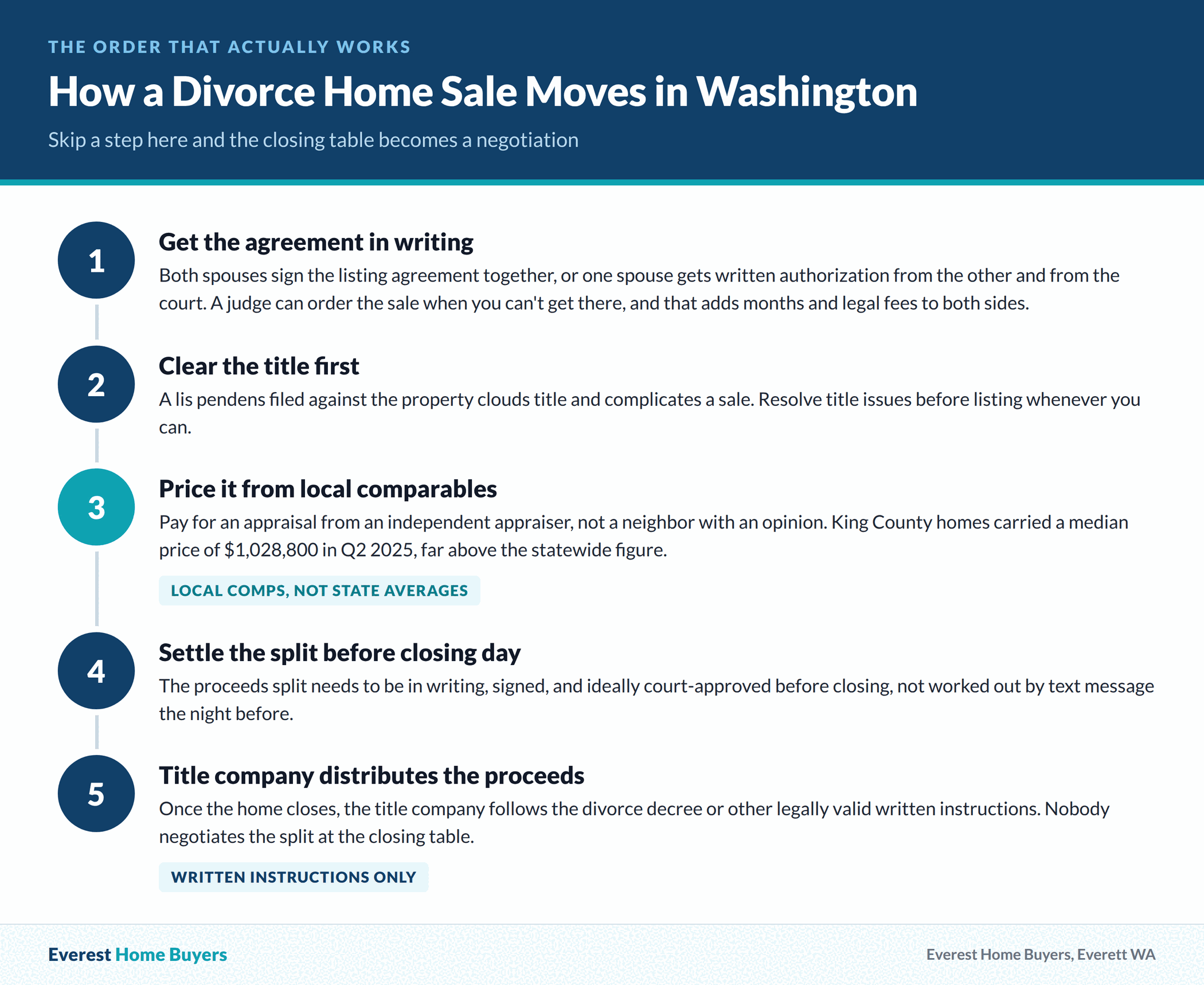
Both spouses sign the listing agreement together, or one spouse gets written authorization from the other and from the court. A lis pendens filed against the property clouds title and complicates a sale, so resolve title issues before listing whenever you can. An accurate appraisal matters. Pay for one from an independent appraiser, not a neighbor with an opinion. Washington’s home values swing enough between Bellevue and Bellingham that guessing at price costs real money. King County homes carried a median price of $1,028,800 in Q2 2025, far above the statewide figure, so local comparables set your price rather than state averages. I’ve watched owners leave money on the table chasing statewide numbers.
Once the home closes, the title company distributes proceeds according to the divorce decree or other legally valid written instructions. Nobody negotiates the split at the closing table. Every number has to be agreed on before that day, not during it.
For couples who want to skip the listing process entirely, Everest Home Buyers buys homes directly, as-is, with no agent commissions eating into the proceeds. That simplifies the financial math when two people are already buried under attorney fees and the emotional weight of everything else.
How the Sale Proceeds Get Distributed Between Divorcing Spouses in Washington
I used to assume the split always landed at 50/50. The law disabused me of that quickly.
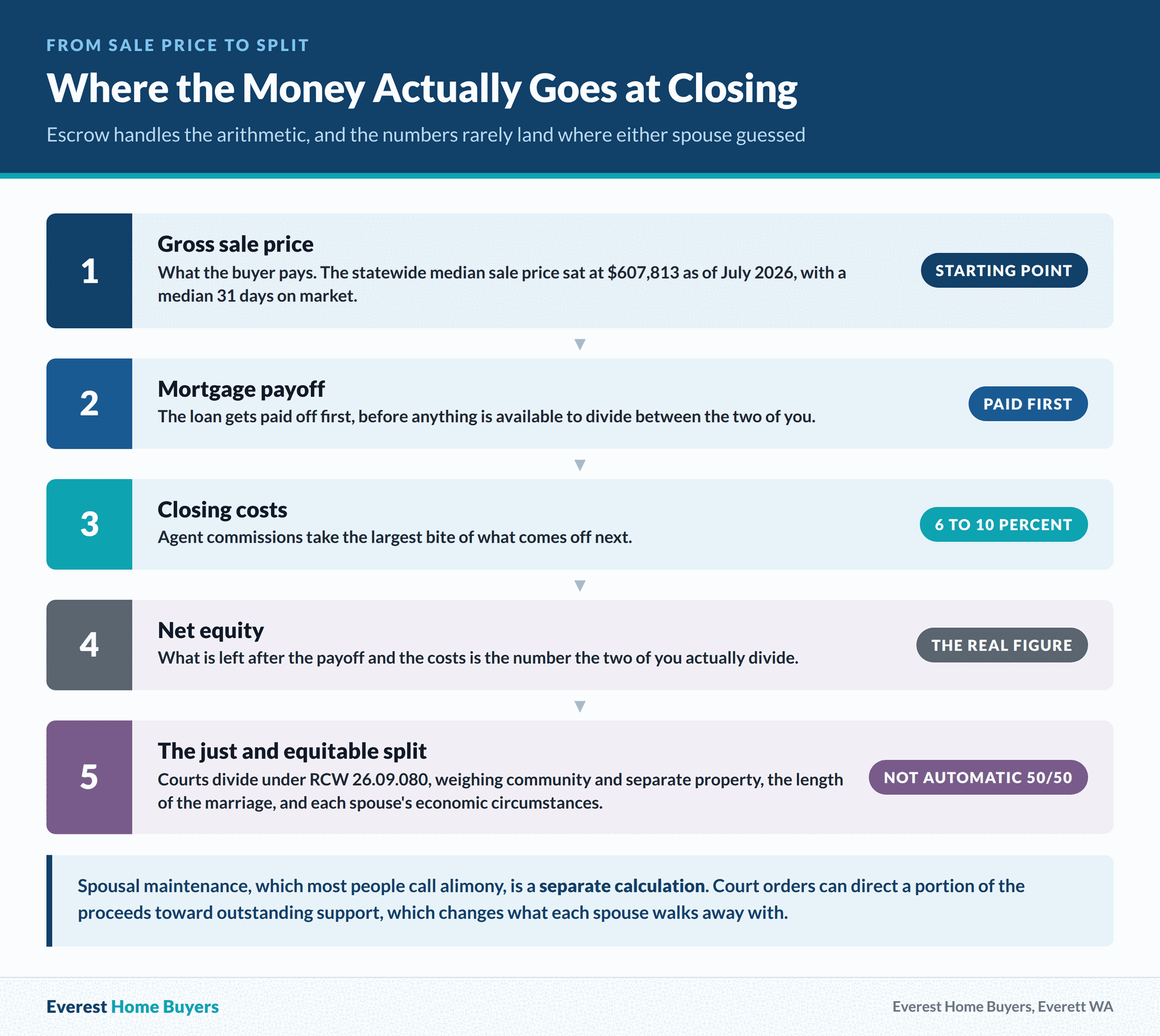
Washington’s “just and equitable” standard means the court looks at the whole picture before it lands on a number. Separate-property contributions, including pre-marital equity or inheritance money put toward the home, may move the split. Document those claims with an attorney well before closing, because paper trails that seem obvious now get surprisingly hard to reconstruct later.
From the gross sale price, the mortgage gets paid off first. Closing costs come next, running between 6 and 10 percent of the sale price, with agent commissions taking the largest bite. What’s left is the net equity available to divide. Escrow handles the arithmetic, and the numbers rarely land where either of you guessed. Spousal maintenance, which most people call alimony, is a separate calculation that can also change how much each spouse walks away with, since court orders can direct a portion of proceeds toward outstanding support.
One spouse can refinance the mortgage into their own name and pay the other an equity share in a buyout. Qualifying for that loan on a single income is the catch, and it bites hard in markets like Bellevue where home values regularly run past $1 million. Mortgage rates and lending standards at the time of the buyout decide whether the option works at all. Run the numbers with a lender before you promise anyone anything. When the refinancing numbers don’t work, selling tends to be the only practical path left.
Tax Consequences of Selling a Home During Divorce in Washington
Get this part wrong and you hand money to the IRS that you didn’t have to.
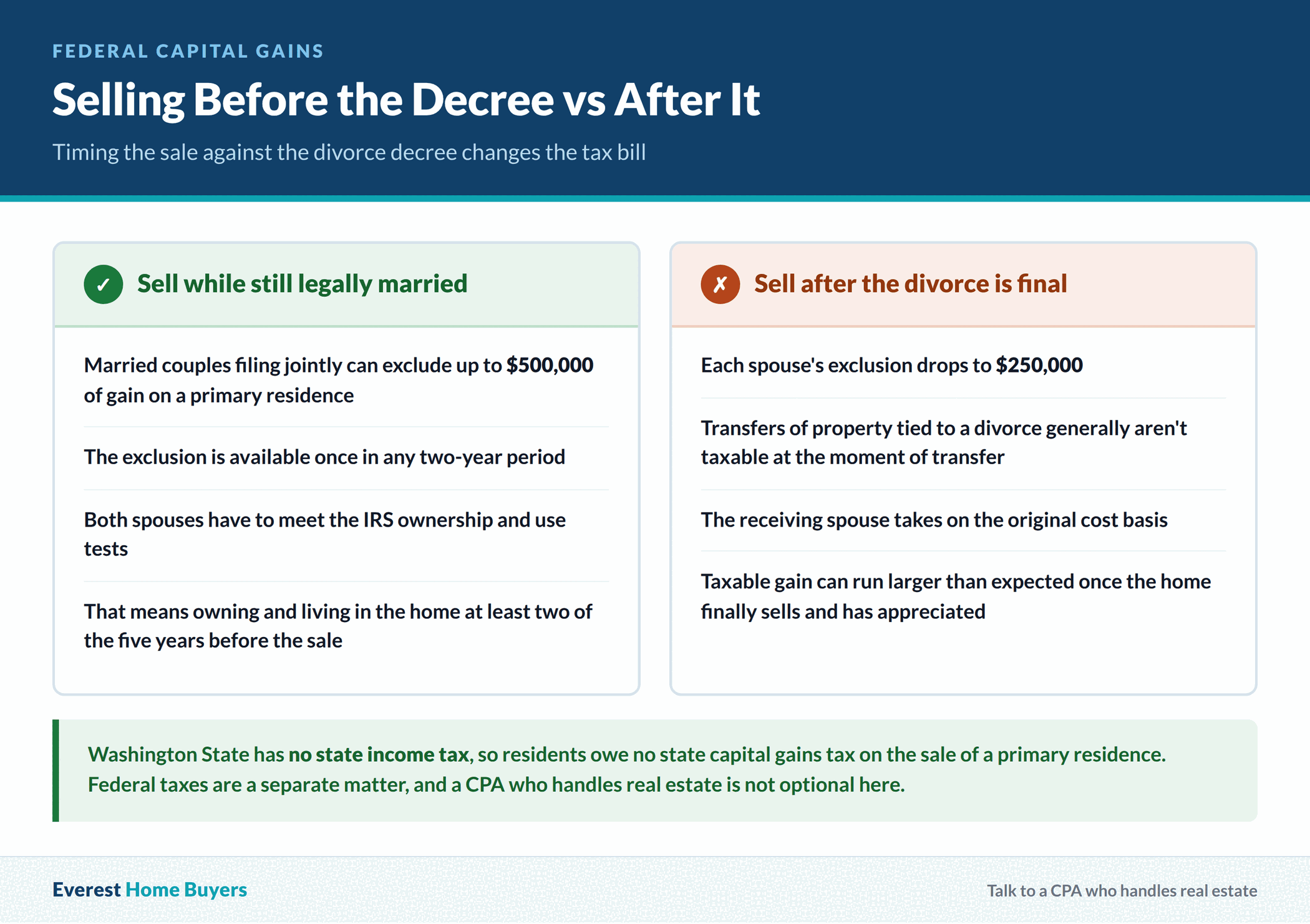
Washington State has no state income tax, so residents owe no state capital gains tax on the sale of a primary residence. That’s one of the genuine advantages of selling here. Federal taxes are a separate matter.
Married couples filing jointly can exclude up to $500,000 of gain from the sale of a primary residence, though that exclusion is available only once in any two-year period. Both spouses have to meet the IRS ownership and use tests to claim the full amount. That means owning and living in the home for at least two of the five years before the sale. Selling before the divorce decree is final, while you’re still legally married, gives you the best shot at the joint exclusion and shields up to half a million dollars from federal capital gains tax.
Post-divorce, each spouse’s exclusion drops to $250,000. Transfers of property tied to a divorce are generally not taxable at the moment of transfer. The receiving spouse takes on the original cost basis, though, so the taxable gain can run larger than expected when the home finally sells and the property has appreciated. Ask about basis early, well before signing day.
A CPA who handles real estate transactions isn’t optional here. Timing the sale against the divorce decree can be the difference between a large tax bill and none at all.
Common Mistakes Washington Couples Make When Selling During Divorce
Roughly 37.5 percent more single-family homes were listed for sale statewide in Q2 2025 than a year earlier, which handed buyers more options and more negotiating leverage. Pricing a divorce sale too high in a market with expanding inventory is a fast way to sit for months.
More than anything else, I watch anger drive the pricing conversation. One spouse holds out for a number no Renton or Redmond comparable supports, out of grief or out of a refusal to let the other spouse “win” a fast sale. The house lingers. Showings dry up by week six. It reduces once, reduces twice, and sells for less than an aggressive first price would have earned. The holdout spouse wins nothing either.
Skipping the attorney review of the divorce settlement before the listing goes live is another one. The proceeds split needs to be in writing, signed, and ideally court-approved before closing day, not worked out by text message the night before. Title companies follow written legal instructions. They don’t resolve verbal disputes at the closing table.
A seller in Edmonds called Everest Home Buyers after a job transfer gave her five weeks to be completely out of the state. Her soon-to-be-ex had agreed in writing to the sale and the split. The house came with a detached garage full of tools and equipment neither party wanted to handle. We made an offer that accounted for the property as-is, she left the garage contents behind, and we took care of the rest. Certainty about the close date mattered far more to her than squeezing out every last dollar, and that’s a reasonable trade when time is the scarce resource.
Finally, skipping a formal appraisal or comparative market analysis is a mistake that rewards whoever bluffs best. Both spouses deserve an objective number from someone with no stake in the outcome.
Frequently Asked Questions
How Hard Is It to Sell a House During a Divorce?
It’s harder than a standard sale, mostly because two people in conflict have to agree on price, timing, and next steps all at once. When both spouses can coordinate and have a written settlement in place, a sale moves quickly. When they disagree, or when pending court orders restrict the property, expect the process to take longer and cost more in legal fees.
What Assets Cannot Be Touched in a Divorce in Washington?
Separate property covers assets one spouse owned before the marriage, received as an inheritance, or was gifted individually during the marriage, and it’s generally protected from division. That legal protection erodes when separate funds get mixed with marital funds over time. Your attorney is the right person to trace and document any separate property claims before you negotiate a settlement.
What Is the Biggest Mistake During a Divorce?
Letting the emotional conflict drive financial decisions costs people the most money. Holding out on a home sale to delay the other spouse, or refusing a fair offer out of spite, usually backfires. Both parties end up paying more in carrying costs and legal fees than the standoff was worth. Decisions made from anger tend to reverse themselves later, at a higher price.
What Is a Wife Entitled to in a Divorce in Washington?
Washington’s community property law applies equally to both spouses, so the question works both ways. Courts divide marital assets by a “just and equitable” standard under RCW § 26.09.080. Judges weigh the nature of community and separate property, the length of the marriage, and each spouse’s economic circumstances at the time of the split. That can land on a 50/50 division, or it can tilt toward one spouse depending on the facts. Spousal maintenance may also be awarded separately from the property division.
If you’re staring down a divorce and a house you don’t know what to do with, you don’t have to sort it out alone. Everest Home Buyers works with homeowners in exactly this spot across Washington State, no repairs, no showings, no waiting on a buyer’s loan to fund. Reach out when you want to talk through your options. No pressure, no obligation.
Selling a Divorce Home Around Everett and Puget Sound
Everett and the towns around it are where we spend most of our time. The median Everett home sold for $594,702 in July 2026 according to Redfin, which is a lot of equity for two people to divide under a court order. Whether you want cash home buyers in Everett, a company that buys homes in Kirkland, or investor home buyers in Tacoma, the city page spells out what we cover there. When a spouse in uniform complicates the timing, our post on military divorce in Everett, WA goes deeper on that piece.
When You Want a Straight Answer About the House
Neither of you has to decide anything today. The Everest Home Buyers team has bought houses out of divorces where both spouses sat in the same room, and out of ones where the two attorneys did all the talking. If you want to see how our process works before anyone signs a thing, start there, or check out other frequent questions sellers ask us. When you’re ready, contact us and tell us where the case stands. The form below reaches us directly, and nothing about it commits you or your spouse to a sale.